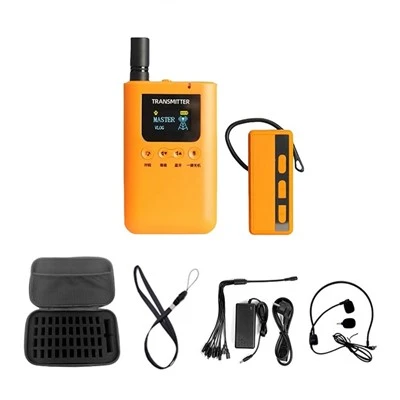
As a provider of long-distance transmission tour guide systems, I've been deeply involved in the intricate details of how these systems function and perform in various environments. One of the most frequently asked questions by our clients is about the relationship between the power consumption of our tour guide systems and the distance of transmission. In this blog, I'll delve into this topic, exploring the scientific principles behind it, and how it impacts the practical use of our products.
Understanding the Long - distance Transmission Tour Guide System
Our long - distance transmission tour guide systems are designed to provide seamless communication between tour guides and their groups, regardless of the physical distance. They come in different configurations, such as the One-to-Many Tour Guide Device, which allows one guide to communicate with multiple tourists, and the Many-to-many Tour Guide Device, which enables several guides and tourists to interact freely. These systems are widely used in various settings, including museums, as seen in the Tour Guide System for Museums.
The core of these systems is the wireless technology used for transmission. It can be based on radio frequency (RF), infrared, or Wi - Fi, each with its own characteristics and limitations. However, regardless of the technology, the power consumption of the system is a critical factor that affects its usability and battery life.
Factors Affecting Power Consumption in Long - distance Transmission
To understand how power consumption changes with distance, we first need to examine the factors that influence power consumption in long - distance transmission tour guide systems.
Signal Strength and Propagation
In wireless communication, the signal strength decreases as the distance from the transmitter increases. This is due to the spreading of the signal over a larger area (free - space path loss) and interference from obstacles such as walls, trees, and other electronic devices. To maintain a reliable communication link over a long distance, the transmitter needs to increase its power output. According to the Friis transmission equation, the received power Pr is inversely proportional to the square of the distance d between the transmitter and the receiver:
Pr = (Pt * Gt * Gr * λ²) / ((4πd)² * L)
where Pt is the transmitted power, Gt and Gr are the antenna gains of the transmitter and receiver respectively, λ is the wavelength of the signal, and L is the system loss factor. As the distance d increases, the received power Pr decreases. To keep Pr above a certain threshold for proper communication, Pt needs to be increased, which directly leads to higher power consumption.
Transmission Rate and Data Volume
The transmission rate and the amount of data being sent also play a role in power consumption. Higher transmission rates require more power because the transmitter needs to change its signal state more frequently. In our tour guide systems, the data being transmitted includes voice signals, which may have different bit rates depending on the quality settings. A higher - quality voice signal with a higher bit rate will consume more power than a lower - quality one.
Environmental Interference
The environment in which the tour guide system operates can significantly affect power consumption. In an area with high levels of electromagnetic interference, the transmitter may need to increase its power output to ensure that the signal can be received clearly. For example, in a crowded city center with many electronic devices, the power consumption of our Wireless Tour Guide Device may be higher compared to a rural area with less interference.
How Power Consumption Changes with Distance
Based on the above factors, we can analyze how the power consumption of our long - distance transmission tour guide systems changes with distance.
Initial Stage: Low Power Consumption at Short Distances
At short distances, the signal strength is relatively high, and the transmitter can operate at a low power level to maintain a reliable communication link. The free - space path loss is minimal, and there is less need to compensate for signal attenuation. In this stage, the power consumption of the system is mainly determined by the basic operating functions of the device, such as the power required to run the internal circuits and process the voice signals.
Intermediate Stage: Gradual Increase in Power Consumption
As the distance between the transmitter and the receiver increases, the signal strength starts to decrease. The transmitter needs to gradually increase its power output to maintain the signal quality. The power consumption increases approximately in proportion to the square of the distance according to the Friis transmission equation. However, this relationship is not always linear because other factors, such as environmental interference, also come into play. In some cases, the power consumption may increase more rapidly due to the need to overcome interference.
Long - distance Stage: High Power Consumption
At long distances, the power consumption of the system can reach a relatively high level. The transmitter has to operate at a high power level to ensure that the signal can reach the receiver and be decoded correctly. In addition, the system may need to use more sophisticated error - correction techniques to deal with the high bit - error rate caused by the weak signal, which further increases the power consumption.
Practical Implications for Users
The relationship between power consumption and distance has several practical implications for users of our long - distance transmission tour guide systems.
Battery Life
The power consumption directly affects the battery life of the devices. In applications where long - distance transmission is required, users may need to replace or recharge the batteries more frequently. For example, in a large - scale outdoor tour, the tour guide and the tourists may need to carry spare batteries to ensure that the system can operate continuously throughout the tour.
System Performance
High power consumption may also affect the performance of the system. When the battery level is low, the system may not be able to maintain the required power output, leading to a decrease in signal strength and communication quality. This can result in interrupted voice transmission or even complete loss of connection.
Cost - effectiveness
Considering the cost of replacing batteries or using rechargeable battery systems, the high power consumption at long distances may impact the cost - effectiveness of the tour guide system. Our company is constantly researching and developing new technologies to optimize power consumption and reduce the overall cost of ownership for our customers.
Our Company's Solutions
As a provider of Reliable Tour Guide System, we are committed to addressing the issue of power consumption and distance.
Advanced Antenna Design
We use advanced antenna designs to improve the signal strength and directivity of our transmitters and receivers. This helps to reduce the power required to maintain a reliable communication link over a long distance. Our antennas are optimized for different frequency bands and environmental conditions, ensuring maximum performance.


Power Management Algorithms
Our tour guide systems are equipped with sophisticated power management algorithms. These algorithms can automatically adjust the power output of the transmitter based on the distance to the receiver and the environmental conditions. For example, when the distance is short, the system can operate at a low power level, and when the distance increases, it gradually increases the power output to maintain the signal quality.
Energy - efficient Components
We use energy - efficient components in our devices to reduce the overall power consumption. These components are carefully selected to provide high performance while consuming less power. This not only extends the battery life of the devices but also reduces the environmental impact.
Conclusion and Invitation
In conclusion, the power consumption of our long - distance transmission tour guide systems changes significantly with distance. Understanding this relationship is crucial for users to make informed decisions about the use and maintenance of the systems. At our company, we are dedicated to providing high - quality, energy - efficient tour guide systems that can meet the needs of various applications.
If you are interested in our long - distance transmission tour guide systems or have any questions about power consumption and other aspects, please feel free to contact us for a detailed discussion. We are looking forward to the opportunity to work with you and provide you with the best solutions for your tour guide needs.
References
- Rappaport, T. S. (2002). Wireless Communications: Principles and Practice. Prentice Hall.
- Haykin, S. (2001). Communication Systems. Wiley.
- Lee, W. C. Y. (1982). Mobile Communications Engineering. McGraw - Hill.