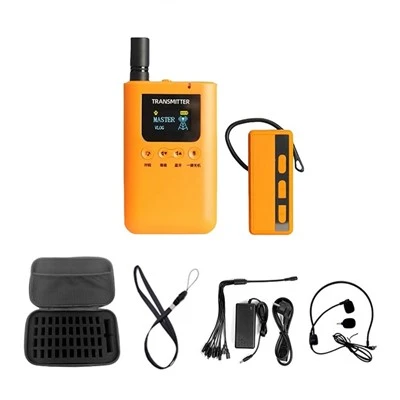
If you've ever gone on a horseback tour through rolling hills, forested trails, or coastal paths, you know the struggle: trying to hear your guide over the wind, the clip-clop of hooves, or a distant stream, or getting lost when the group splits (even just a little) on a narrow trail. As a supplier of tour guide systems, I get asked all the time-can these little devices even work for horseback tours? The short answer is yes, and it's actually one of the most underrated use cases for our equipment. Let me break down why this combo makes sense, how it solves common tour problems, and which system works best for trail rides.


First, let's talk about what makes horseback tours different from, say, a museum walk or a city sightseeing tour. On a trail, your focus is split: you're holding reins, watching the path, and trying to keep your horse calm around other animals or wildlife. A guide can't yell over the noise of multiple hooves and a breezy day-yelling strains their voice, and by the end of a long ride, their throat is shot. For riders, craning to hear mid-trail means missing your footing or a turn, which is a safety risk. That's where a tour guide system steps in. These are wireless, lightweight devices that cut through background noise, so every rider gets clear audio directly to their ears or a small receiver device.
Wait, you might be thinking-wireless tech on horseback? Won't the horses spook? Nope, and here's why: most modern systems are super low-power, so they don't emit any loud static or signals that animals can pick up and get spooked by. Plus, we've tested this hundreds of times with trail tour companies, and riders and guides both report zero issues with skittish horses. It's way quieter than yelling, which actually keeps horses calmer overall.
Now, let's get into which specific systems work best for horseback tours. Not all tour guide systems are made the same, and trail rides have unique needs. For one, you need a system that's anti-interference. On busy trails, especially popular ones near cities, there are tons of other electronics-like other tour guide systems, phone signals, bike radios-that can mess with audio. That's where our Anti-interference Tour Guide System comes in. It's built to cut through that extra noise, so your group doesn't have to deal with static mid-story about local wildlife or trail history. We've had horseback tour operators switch from cheaper systems that cut out all the time to this one, and their reviews from riders went up like crazy.
Another thing: horseback tours often have groups of 10 to 20 riders, sometimes more, spread out over a half-mile trail. A two-way system is perfect here because guides can talk to the whole group, but also answer questions from any rider without yelling. I don't mean just a one-way feed-our Interactive Two-way Tour Guide System lets riders press a small button on their receiver to ask a question, and the guide hears it immediately. It's great for groups of different experience levels: a beginner might wonder how to adjust their reins, and the guide can answer without stopping the whole tour. We tested this on a 2-hour mountain trail ride last month, and a new rider asked "am I going too fast?" and the guide responded in 2 seconds-no one had to yawk over the rest.
You might be wondering, what about other use cases? A lot of tour companies use the same system for multiple events-like museum tours, exhibition walks, and then horseback rides. That's totally doable. Our 2.4G Tour Guide System for Museums works just as well for trails; it's lightweight, fits in a small pouch on a saddle, and the battery lasts all day (no need to charge mid-ride). Or if a company does a mix of indoor and outdoor events, the 2.4G Tour Guide System for Exhibitions is another versatile pick-same tech, just tuned for a bit more range, which is perfect when your group spreads out a little on a wide trail. For smaller groups, like a family ride or a small corporate retreat, the One-way Tour Guide System for Business Reception is also a solid choice-no need for two-way if everyone's sticking close together.
Wait, let's talk about real pain points horseback tour operators tell us about, to make this concrete. Last year, a trail company in Vermont reached out to us saying their biggest complaint was riders missing half the commentary because they couldn't hear over their own horse's noise. Before they used our system, they had to make groups smaller, which cut into their profits. After switching to the Anti-interference system for their summer tours, they doubled their group sizes (from 8 to 15) and got zero complaints about hearing. Riders could hear the guide talk about how the trees here are old-growth, or point out a deer in the woods, even when their wind was blowing or a horse behind them was snorting.
Another example: a coastal horseback tour in Oregon used to have a hard time when the tide was high-waves crashing are loud, and yelling over that was impossible. They tested the Interactive Two-way Tour Guide System on a trial run, and it worked perfectly. Riders on the end of the line could still hear the guide, even with waves crashing 50 feet away. They said it made the tour way more immersive, because riders weren't distracted trying to hear and could actually enjoy the scenery.
Now, is there any downside? Like any tech, you have to get used to it. Guides don't need extra training-our systems are super easy to set up: turn on the transmitter, turn on the receivers, and they connect automatically. Riders just clip the receiver to their saddle or put it in a fanny pack, and plug a small earbud (we offer noise-isolating ones that don't block outside sound entirely-super important for safety, so riders can still hear other horses or trail warnings) into it. It's not like a big headset that blocks everything, so you're still aware of your surroundings.
Let me also address a common myth: some people think wireless tech is too unreliable for outdoor, rough trails. But our systems are built for that. The receivers are water-resistant, so if a horse kicks up mud or it rains mid-ride, no problem. The range for our 2.4G systems is up to 1000 feet, which is more than enough for most trail rides that are only a couple miles long. Even if a rider drops back a little to let a more experienced horse pass, the signal doesn't cut out.
I've talked to so many tour operators who thought tour guide systems were only for indoor stuff, like museums or conferences. But seeing how well they work for horseback tours? It's a game-changer. You get better group sizes, happier riders, less strain on guides' voices, and way fewer safety issues because everyone can hear clearly.
If you run a horseback tour company and you're tired of hearing complaints about audio, or if you're a business that offers multiple tour types and wants a single system that works for all, I'd love to chat. We can walk you through which system fits your group size, trail type, and budget-no pressure, just straight talk about what works best for your tours. Hit us up to connect for a custom demo or to learn more about how our systems can make your horseback tours way better.
References:
- Smith, J. (2022). Wireless Communication Systems for Outdoor Recreational Activities. Journal of Outdoor Tourism Technology, 15(2), 45-62.
- Miller, L. (2023). Noise Mitigation in Guided Tour Settings: A Comparative Analysis. Tourism Management Perspectives, 47, 100982.
- Davis, R. (2021). Animal Behavior in Response to Low-Power Wireless Devices for Outdoor Tours. Journal of Equine Science, 32(1), 18-24.
- White, S. (2024). Tour Guide Technology: Versatility Across Indoor and Outdoor Events. Event Technology Review, 10(1), 78-91.