


A megaphone is the cheapest way to be heard by a group, and for a small party on a quiet path it does the job. It stops working when the group gets large, the surroundings get loud, or the tour runs for hours.
If you recognize any of those situations, a wireless tour guide system is worth a look. This guide covers the signs that it's time to switch, what actually changes, and the cases where a megaphone is still the better choice.
Why a Megaphone Gets Harder to Use as Groups Grow
A megaphone sends the guide's voice outward to everyone in range, not just the group. People standing near the guide hear the loudest sound, while those at the back of a large group still struggle to follow.
The guide also has to keep speaking at a raised volume, tour after tour, which wears the voice down.
Other visitors nearby hear every word too. That becomes a problem in museums, churches, markets and other shared spaces. Some venues limit amplified sound, so check the site's rules before you rely on a megaphone.

Signs It's Time to Switch
Your groups are large. Once a group stretches out in a long line, the people at the back lose the guide.
The place is noisy. Street markets, busy squares and factory floors force the guide to shout over the background.
The tours are long. Speaking loudly for hours at a stretch is tiring, and it gets worse over a full season.
Several groups share one space. Two megaphones in the same square mean each group hears the other guide.
The venue asks for quiet. If a site restricts loudspeakers, a megaphone is no longer an option.
If two or more of these apply to you, switching is worth considering.

What Changes With a Wireless Tour Guide System
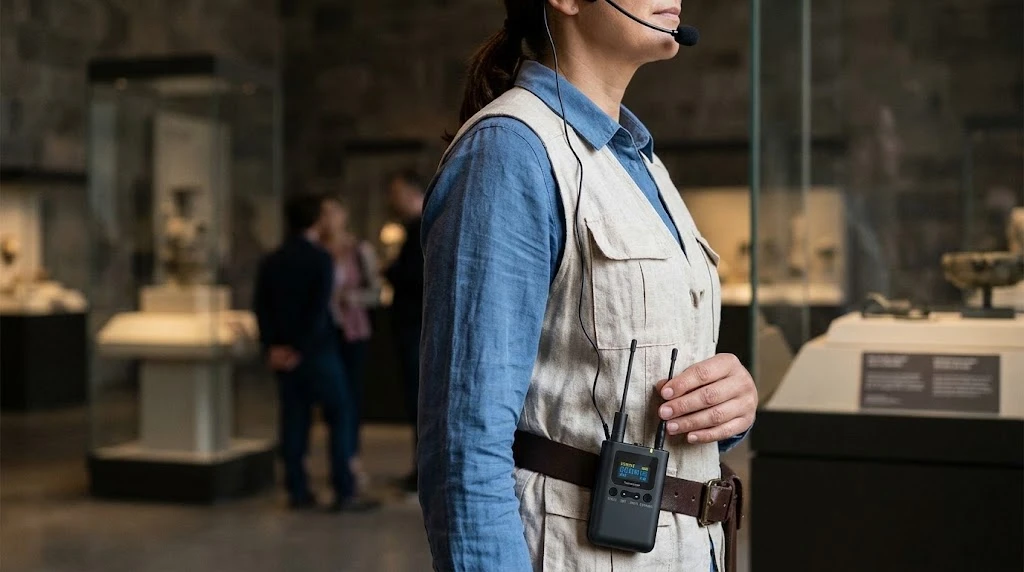
In a wireless tour guide system, the guide speaks into a microphone connected to a transmitter, and each visitor wears a receiver with an earphone. The guide speaks at a normal level, and the sound goes straight to each listener.
In practice, three things change. Visitors can stand where they can see the exhibit instead of crowding around the guide. The guide's voice no longer spills into the space around the group. And several groups can work in the same place on separate channels.
When a Megaphone Is Still Enough
A megaphone is fine for small groups, quiet outdoor settings and tours you run only occasionally. In those cases, new equipment adds cost and handling without solving a real problem.
A simple test: if no visitor has ever said they couldn't hear, and the guide finishes the day with a normal voice, there is no need to switch.

What You Need to Make the Switch
A basic setup has three parts: one transmitter with a microphone for each guide, one receiver for each visitor plus spares, and a way to charge and clean the receivers. Our guides on [how many tour guide receivers to buy] and [renting or buying a tour guide system] help you size the order and decide how to pay for it.
The YingMi L7 is one example of this kind of system. The guide wears a headset microphone, which keeps both hands free, and each receiver weighs 15 g. Kits start with one transmitter and 20 receivers, and larger kits come with 50-slot charging boxes, up to 500 receivers. The charging box also disinfects the receivers, which helps when earpieces are shared between groups.
FAQs
Q: Is a wireless tour guide system better than a megaphone for large groups?
A: Usually, yes. Each visitor hears the guide directly, so people at the back of the group hear as well as people at the front. The guide also doesn't have to raise their voice.
Q: Will a wireless system reduce voice strain for tour guides?
A: It usually does, because the guide speaks into a microphone at a normal volume instead of raising their voice to carry over a crowd.
Q: Can I use a megaphone for some tours and a wireless system for others?
A: Yes. Nothing stops you from using a megaphone for small, quiet tours and a wireless system for large or noisy ones.
Q: How many receivers do I need when I switch?
A: Count your largest group plus a few for staff, then add spares. Our sizing guide shows how to work out the number.


