


A sample order costs little compared with a bulk order, but only if you use it to look for problems. Plugging a receiver in, hearing your own voice and deciding it "works" tells you very little.
Below is what to test, roughly in the order that makes sense, and what to ask the supplier while you wait. Write the results down as you go. Two suppliers' samples are hard to compare from memory.
Open the box and count
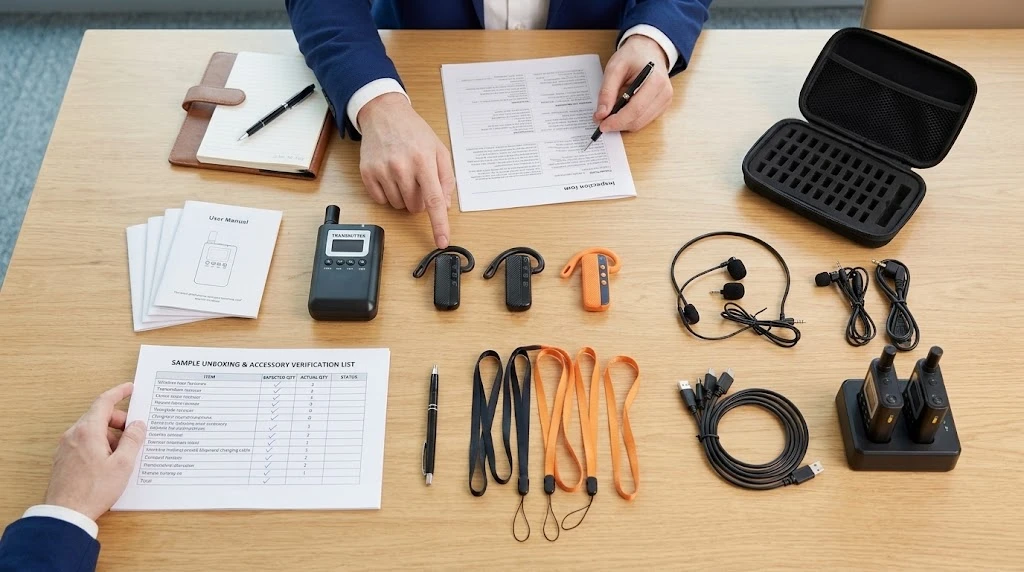
Compare the contents with your quotation line by line: transmitters, receivers, earphones, headset microphones, lanyards, cables and the charging case. Missing items are easy to sort out at the sample stage and awkward once 500 units have shipped.
Read the printed manual while you're at it. If you can't work out how to change channels from the manual alone, your customers won't be able to either.
Does the sample match the data sheet?
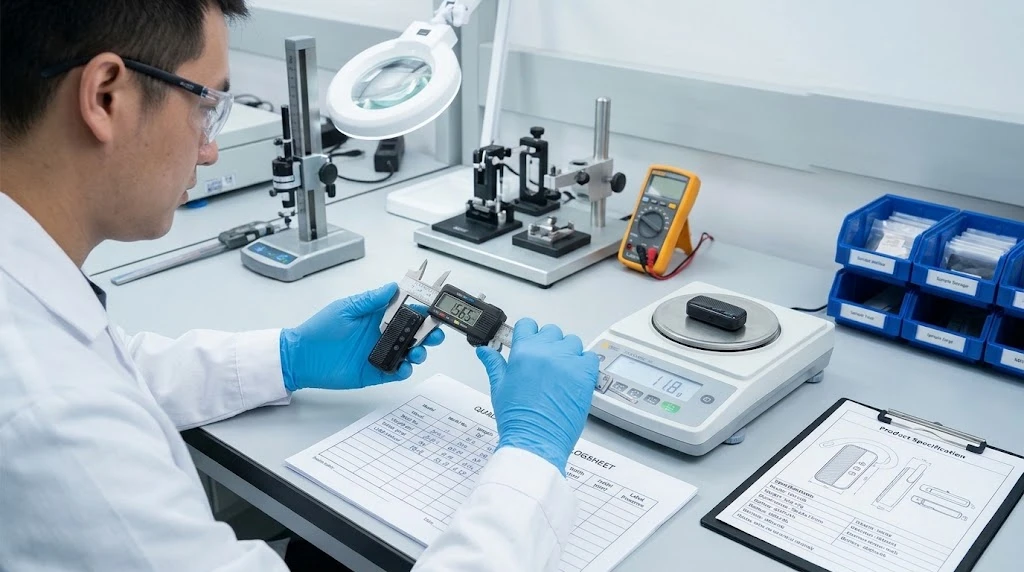
Weigh a receiver, measure it, and read the frequency band printed on the unit or in the manual. Small differences are normal. Anything you can see for yourself should go back to the supplier before you order.
The frequency band deserves its own check. Allowed bands differ from country to country, so look yours up against local rules. If the supplier's standard band isn't allowed where you sell, ask whether another one can be supplied.
Listening tests: a quiet room, then a noisy one
Have someone speak into the transmitter at a normal volume while you listen. Pay attention to clarity, hiss in the background, and whether the loudest setting is loud enough for a busy street.
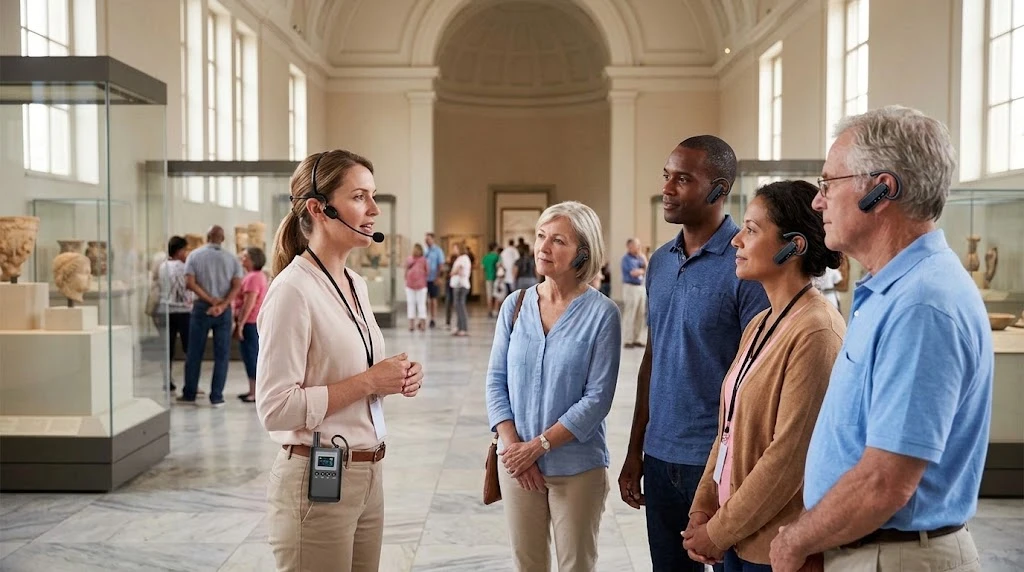
Then repeat the test somewhere noisy. For museum customers, an echoing hall is the right place. For tour operators, try a roadside or a crowd.
Finally, wear the earphone for an hour. Discomfort rarely shows in a five-minute test, and visitors who are uncomfortable simply take the earphone out.
Range: measure it yourself
Data sheets usually quote range in open conditions, and your own result will often be shorter. That shorter figure is the one you can safely promise customers.
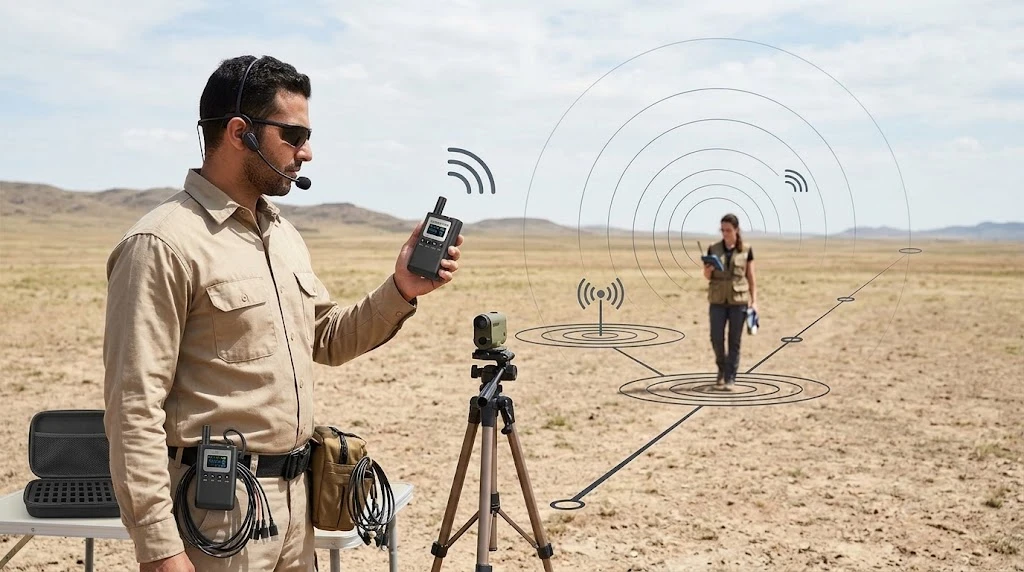
Ask a colleague to talk into the transmitter while you walk away with a receiver, and note where the sound first starts to break up. Do this once in an open space and once indoors, in a corridor or a hall with walls. Try the receiver in a coat pocket and in a bag as well, since bodies and bags get in the way on a real tour.
Two groups, two channels
If the supplier can send enough samples, ask for two transmitters. Put each on a different channel, give each a few receivers, and talk into both. Neither group should hear the other.
Then move the channels closer together and test again. Some tour guide systems cope with neighbouring channels and some don't, which matters if your customers run several groups in the same place.
Notice how long a channel change takes, too. A guide fumbling with a manual in front of a group won't keep using the system for long.
A full day on the battery
Charge a receiver from empty and time it. Then leave it running and see how long it lasts. Compare both numbers with the data sheet.
Use the charging case or cables the way a customer would. Do the units sit firmly in their slots? Can you tell when they are full? A routine that annoys you with ten units will be worse with a hundred.
Comfort and build quality
Press every button, plug and unplug the earphone a few times, clip the lanyard on and off, and drop a receiver into a bag with your keys. Loose connectors, stiff buttons and flimsy clips show up quickly this way.
If the system has Bluetooth, pair it with the phones your customers are likely to carry.
How the supplier handles your questions
While you test, send the supplier a real question. Note how long the answer takes and whether it answers what you asked. It is a fair preview of how they will behave after you have paid.
Ask what happens when a unit fails, who pays for return shipping, and how long a repair takes. At YingMi, a fault report starts with a short video or description, and the team walks the customer through the first checks. If a return is needed, they send instructions and help with the customs paperwork.
From sample to bulk order
A good sample shows what the supplier can build. It doesn't show that 500 units will match it. Ask how they keep production consistent with the sample, and plan to check part of the first batch yourself, or send an inspector, before it ships.
For customized orders, ask what happens between the sample and mass production. At YingMi, the sequence is requirement confirmation, sample creation (a 3D appearance prototype, a circuit board prototype and software debugging), then testing before production starts.
FAQs
Q: What should I test first in a tour guide system sample?
A: Check the box contents and the specs against the data sheet. After that, test sound and range in the places where your customers will use it.
Q: How many samples should I order?
A: Enough for a real test: one transmitter and a few receivers at minimum. If you can get two transmitters, you can also test two groups side by side.
Q: How do I test the range of a tour guide system?
A: Walk away from a talking transmitter and note where the sound first breaks up. Do it once outdoors and once indoors, and record both distances.
Q: Does a good sample mean the bulk order will be the same?
A: Not necessarily. Ask the supplier how they keep production consistent, and check part of the first batch before it ships.


