


Ordering tour guide receivers by gut feeling usually goes wrong in one of two ways. Either the cabinet is full of idle units after the low season, or the busiest Saturday of the year arrives and a group waits at the door for devices to come back from the last tour.
You can avoid both by working the number out from four inputs: your largest group, how many groups run at the same time, a spare allowance, and how long a returned unit takes to be ready again.
Start With Your Largest Group, Not the Average
Your stock has to cover the biggest group you actually run. If most tours have 20 people but a coach party of 45 books twice a month, plan for 45.
Sizing for the average means turning away large groups, and large groups are often the ones that spend the most.
Don't forget the people on the guide's side. Each guide needs a transmitter, and tour leaders, drivers and accompanying staff often want to listen as well. Add one or two receivers per group for them.

Add Up the Groups That Run at the Same Time
A receiver is out of circulation for the whole tour. What matters is how many groups are on the route at once on a busy day, not how many tours you run in total.
Here is a made-up example. A visitor centre runs three tours in parallel on a Saturday morning, with 45, 30 and 25 people. Add two staff receivers per group:
45 + 30 + 25 = 100 visitors, plus 6 staff = 106 receivers in use at the same time.
Groups that run in parallel also need separate channels, otherwise they hear each other's guide. Check that the audio tour guide system you buy offers at least as many channels as the groups you expect to run together. Our article on [tour guide system crosstalk and disconnection] covers this in more detail.
How Many Spares to Keep
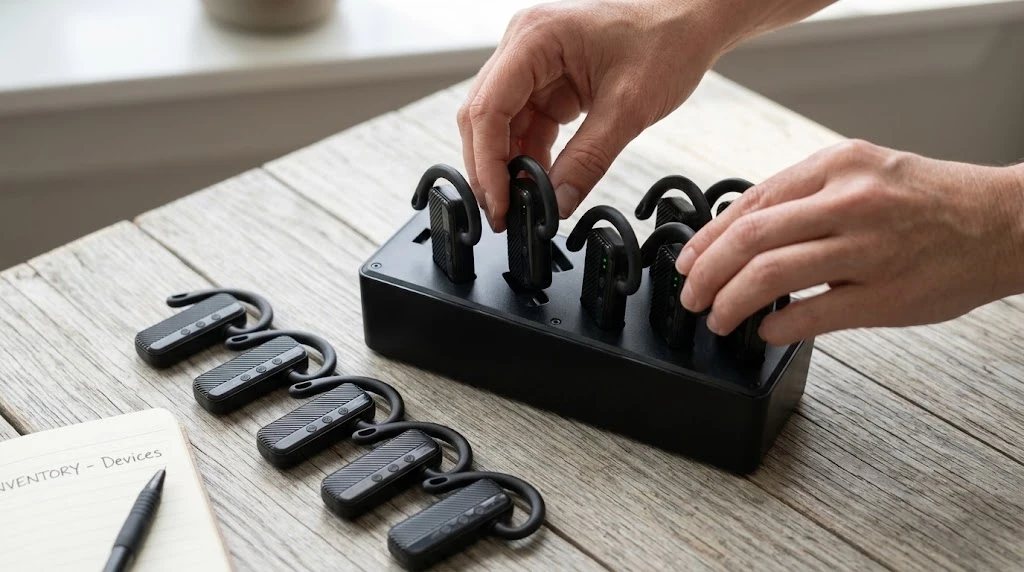
There is no industry rule for spares. A common starting point is around 10% on top of the in-use number, which you then adjust after one season using your own return records.
In the example above, 10% of 106 rounds up to 11, giving 117 receivers.
If receivers leave your counter with no deposit or sign-out, expect higher losses and set the allowance accordingly. Operations with a return check at the end of every tour can usually plan lower.
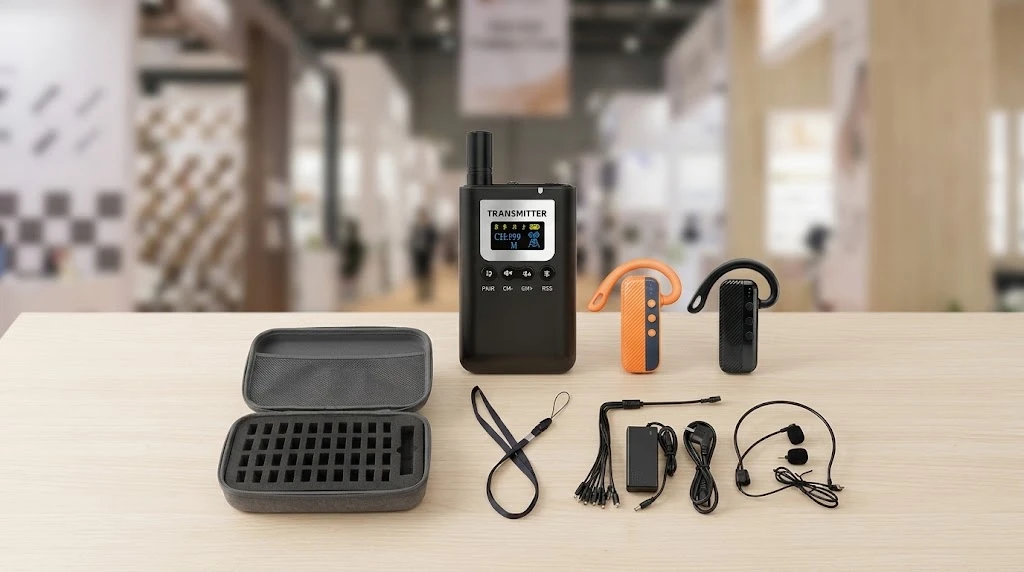
Transmitters need their own spare. A faulty receiver affects one visitor, but a faulty transmitter silences the whole group. Keep at least one spare transmitter, and more if you run many guides.
Allow for Turnaround Between Tours
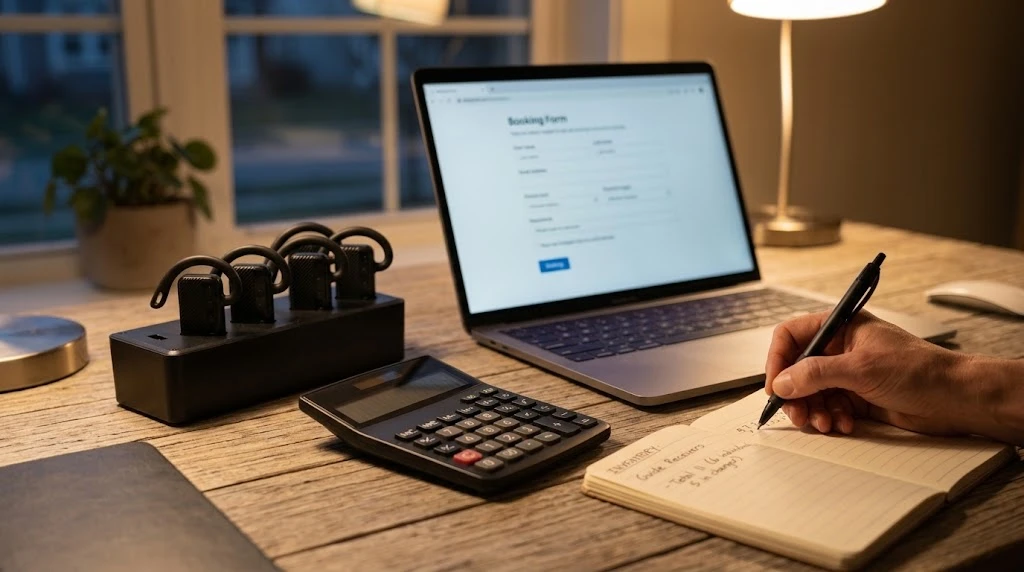
If a morning group returns its receivers at noon and the afternoon group starts at one, those units have to be checked, cleaned and charged in between.
Battery life decides how much extra stock you need. If a fully charged receiver covers your longest day, returned units can go straight back out after cleaning. If it doesn't, you need a second set charging while the first is in use. Check the rated battery life and charging time of the exact model you plan to buy, and use those figures rather than a general estimate.
Charging cases also hold a fixed number of units, so round your final quantity up to whole cases. A stock of 117 does not fit neatly into most case sizes, and half-empty cases waste space on the shelf.
Plan for the Typical Busy Day, Not the Single Busiest
If you buy for the one peak day of the year, most of that stock sits idle for the other 360 days.
A practical check: look at last season's bookings and count how many days went above your planned quantity. If it was only a handful, cover those days by renting units or borrowing from a partner, and keep your own purchase for the days that happen regularly.
If the number of days over your limit keeps growing year after year, that is the signal to add stock.
A Simple Formula to Keep
Receivers to buy = receivers in use at the same time (visitors + staff) + spares + a second set for turnaround, if the battery can't cover a full day
Using the example: 106 in use + 11 spares = 117, then round up to the next full charging case. Add the transmitters separately: one per guide, plus at least one spare.
If you want a second opinion on a quantity, send YingMi your largest group size, how many groups run together and your daily schedule. YingMi main units come with a 2-year warranty, and spare parts stay available long term, which makes it easier to add stock later as your volume grows.
FAQs
Q: How many spare receivers should I order?
A: Start with roughly 10% above the number you use at the same time, then adjust with your own loss and repair records after one season. Keep at least one spare transmitter as well.
Q: Do I need one receiver for every visitor?
A: Yes, for every visitor who wants to listen. If listening is optional, such as in a museum, track what share of visitors take a receiver over a few weeks before planning below the full headcount.
Q: Can one transmitter serve several groups?
A: In a standard one-to-many setup, no. Each group needs its own transmitter and its own channel, so the number of channels limits how many groups can run together.
Q: Do I need extra receivers because of charging time?
A: Only if the battery can't cover your longest day between charges. If it can, returned units only need to be cleaned and checked before going out again.


