

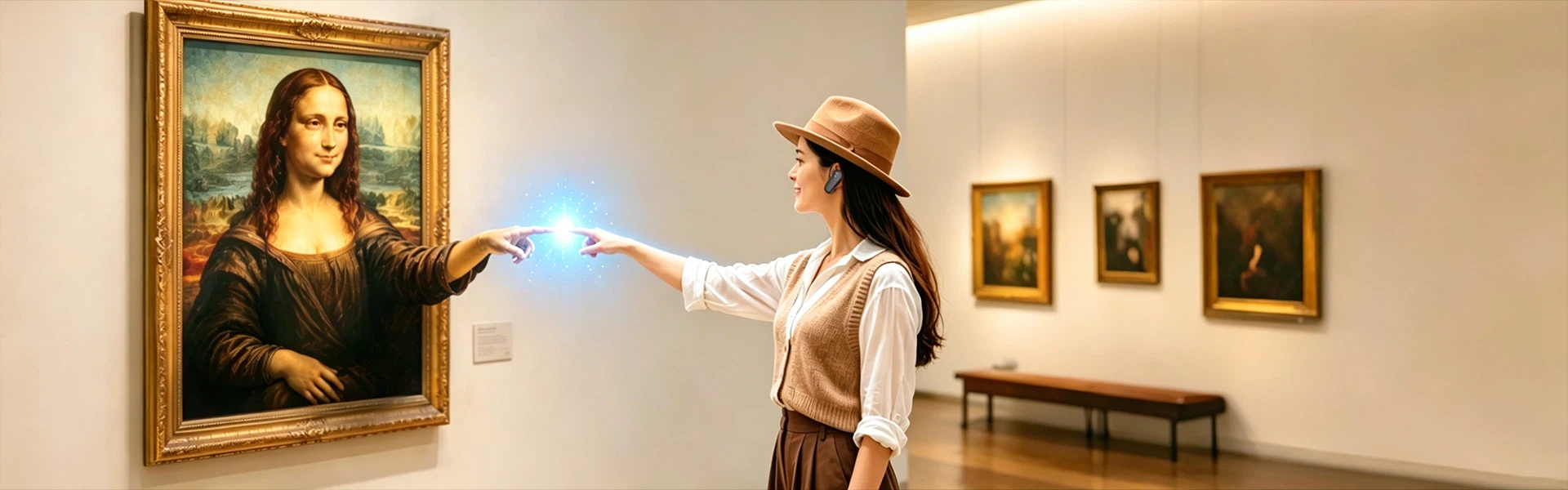
A factory tour puts visitors in the loudest and most hazardous part of the business. Machinery, forklifts, compressed air, and ventilation make ordinary speech hard to follow, while safety rules limit how close a group can stand and what they can wear. For customers, auditors, investors, and prospective suppliers, the tour is often the moment the company earns trust. A guide who cannot be heard undermines that moment.
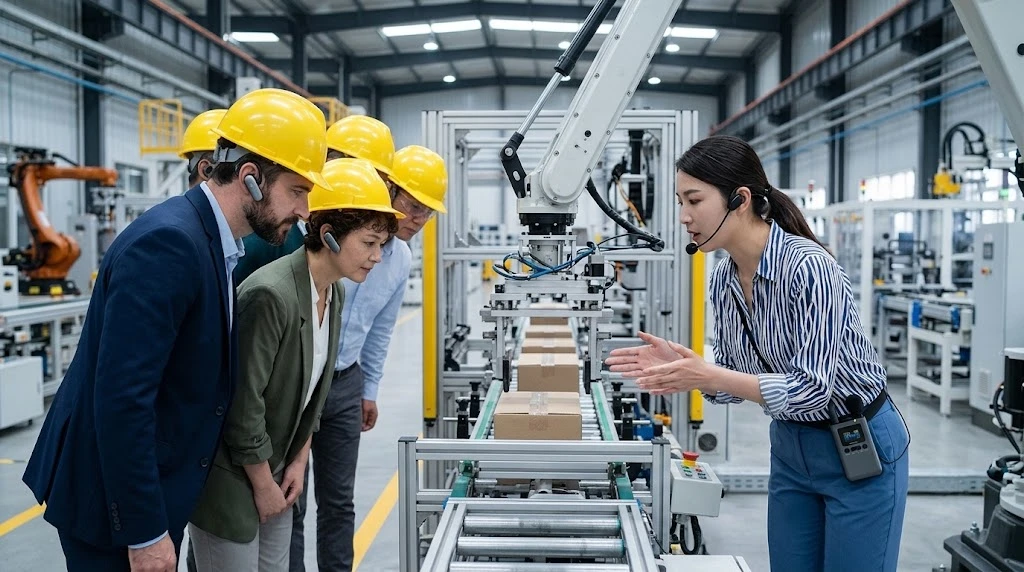
A wireless tour guide system solves the hearing problem, but only if it is planned around the realities of the production floor. This guide covers the conditions that matter, how to set up a tour, and what to check before the first visitor group arrives.
Why Factory Tours Are Harder Than Other Guided Visits
|
Condition |
Effect on the tour |
|---|---|
|
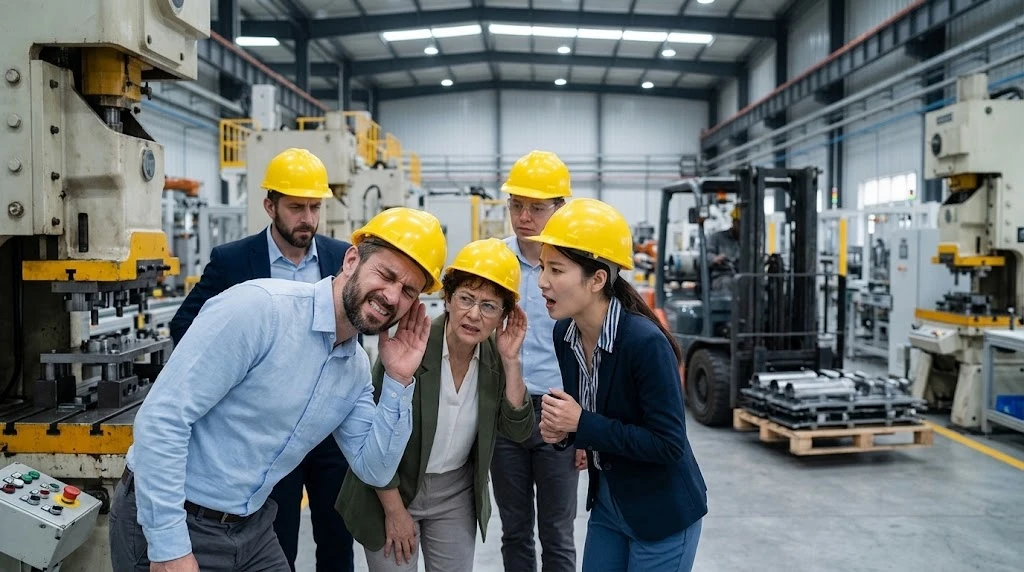
High and constant background noise |
Visitors cannot understand the guide without leaning in, which breaks the group apart |
|
Required protective equipment |
Helmets, safety glasses, and ear protection limit which earphones and microphones can be used |
|
Narrow aisles and marked walkways |
Groups spread out in a line, so the guide is far from the last visitor |
|
Steel structures, large machines, and several floors |
Wireless signals weaken or reflect in unexpected ways |
|
Visitors from different countries |
A single spoken language rarely serves the whole group |
|
Safety obligations |
Visitors must hear warnings and instructions immediately |
A system that performs well in a showroom may struggle under these conditions, so the factory floor itself has to be the test environment.
What the Audio Equipment Must Achieve
The goal is simple to state: every visitor hears the guide clearly, at a comfortable volume, from anywhere along the route, without removing their protective equipment. Four requirements follow from it.
Speech that stays clear in noise
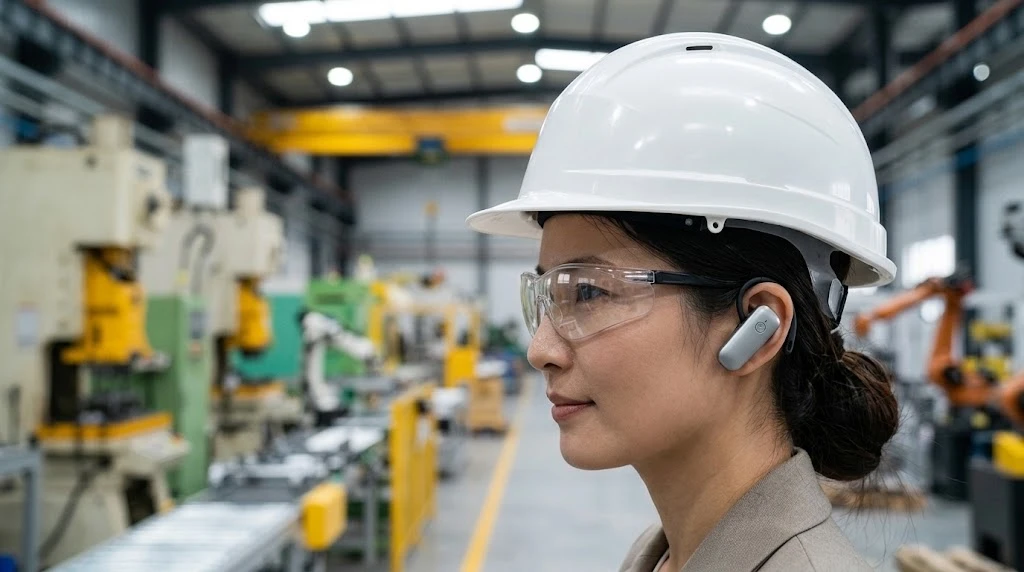
A close-talking microphone, such as a headset type, picks up the guide's voice while reducing the surrounding noise. Receivers should let each visitor set their own volume. Earphones that block part of the outside noise help visitors focus on the commentary.
Earphones that work with protective gear
Over-ear headphones may not fit beneath a helmet, and some earbuds sit poorly under ear defenders. Check the fit with the exact equipment your visitors wear before choosing an earphone style.
Coverage along the whole route
A long production line can stretch the group over a considerable distance. The system must keep the signal stable from the first workstation to the last, including corners, stairwells, and areas near large metal machinery.
Reliability for repeated tours
Factory tours are often scheduled back to back. Equipment must run through a full day, recharge between groups, and survive dust, handling, and the occasional drop.
Planning the Tour Route Around the Audio
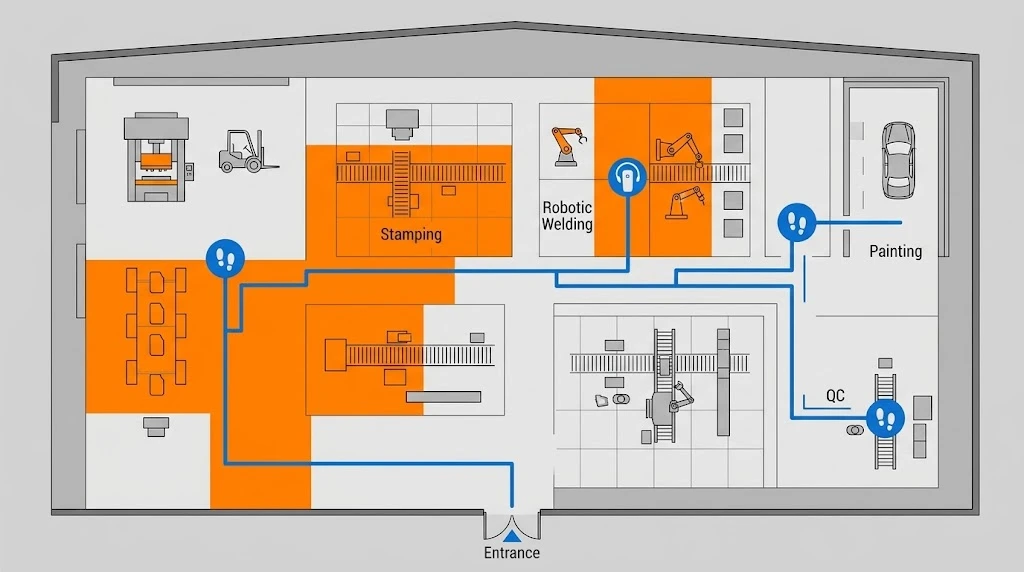
Audio planning belongs in the route design, not after it. Walk through these points with the operations and safety teams:
Mark the loudest points. Identify the stations where background noise is highest. Place the guide's talking points just before or after them, not inside them, whenever the route allows.
Choose stopping places. Select spots where the group can stand safely, see the process, and hear the commentary comfortably.
Check line of sight for the signal. Note where machinery, shelving, or walls might block the signal and test those points first.
Define the sequence of languages. If visitors speak different languages, decide whether the tour will run with separate guides on separate channels or one guide with an interpreter.
Prepare safety messages. Write short instructions for the guide to deliver clearly at hazardous points, and confirm that the audio system carries them reliably.
Setting Up the Visit Day
A consistent routine removes most problems. A reliable sequence looks like this:
Before arrival: confirm the group size and languages, charge all receivers and the guide transmitter, and check spare earphones and replacement batteries or charging capacity.
At reception: hand out the receivers and earphones, and give a short demonstration covering power, volume, and how to wear the earphone with protective equipment.
At the start of the route: do a quick sound check with the group before entering the production area.
During the tour: the guide speaks at a normal pace, because the audio system carries the voice, and checks group members' attention at each stop.
At the end: collect the equipment, clean the earphones, return everything to the charging case, and note any faults.
Language and Multi-Guide Operation
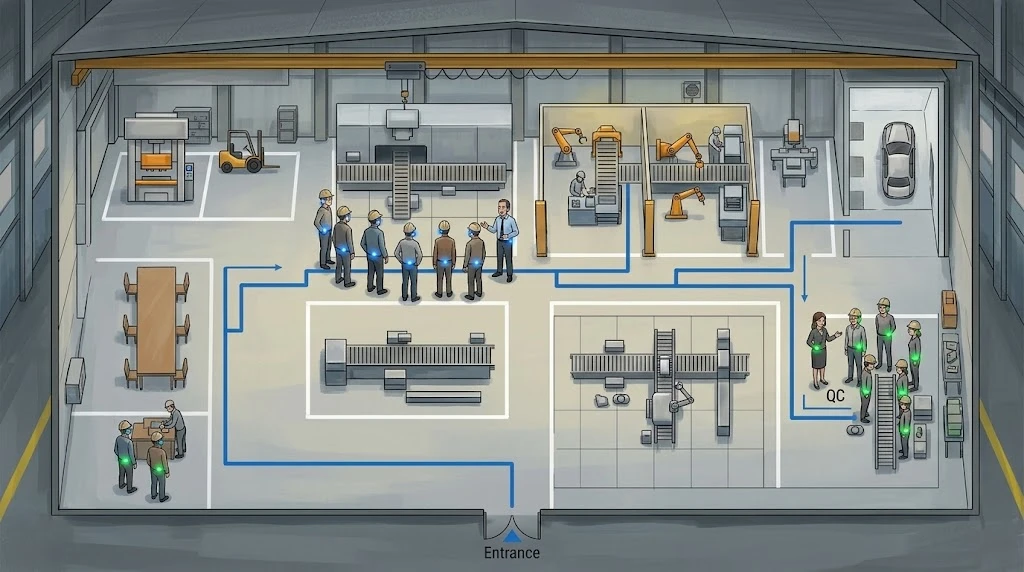
Factories that host international customers often run more than one tour at once. Independent channels let several groups share the same production floor without hearing each other, and they let each group follow a guide in its own language. Before committing to a system, confirm how many channels it provides, how a group is assigned to a channel, and how easy it is for a guide to change channel without help from a technician.
Questions to Ask a Supplier
These questions are more useful than a list of headline specifications:
How does the system perform in high-noise environments, and can it be demonstrated on our site?
Which earphone styles are available, and how do they work with helmets and ear protection?
How many independent channels can run at once in the same building?
How long do the receivers run on a full charge, and how long do they take to recharge?
What does the charging and storage solution look like for our expected number of receivers?
What support and replacement parts are available if units are damaged?
Request verified specifications in writing, and compare them with the supplier's official product documentation.
Common Mistakes in Factory Tour Audio
Testing in a quiet room. A demonstration in a meeting room tells you nothing about the production floor.
Choosing earphones without trying them with protective gear. A comfortable earphone in the office may be unusable under a helmet.
Planning audio after the route is fixed. The best stopping points are those where both safety and hearing work.
Forgetting the charging routine. Several tours in a day demand a fast and organized recharge process.
Ignoring visitors' language needs. A tour that only some visitors understand wastes the effort of the whole visit.
FAQs
Q: Can Visitors Hear The Guide Clearly Next To Loud Machinery?
A: A close-talking microphone and earphones that reduce outside noise make a large difference, but the result depends on the equipment and the environment. Test the system at the loudest point on your route before you commit.
Q: What Earphone Type Works Best With A Safety Helmet?
A: It depends on the helmet and any ear protection in use. Lightweight single-ear or in-ear options often fit better than large headphones, but each combination should be tried on in advance.
Q: How Many Receivers Does A Factory Need?
A: Base the number on your largest regular tour group, then add a margin for units that are charging or out of service. If tours run in parallel, count the receivers for every group separately.
Q: Can Two Tours Run At The Same Time On The Same Floor?
A: Yes, when the system offers independent channels. Assign each group to its own channel and confirm in a trial that the audio does not overlap.
Q: Do Visitors Need Training To Use The Receivers?
A: Only a short demonstration. Well-designed receivers have simple controls, and a brief explanation at reception is usually sufficient.
Q: Is A One-Way Or Two-Way System Better For Factory Tours?
A: One-way is enough for most tours in which the guide explains and visitors listen. A two-way system suits technical walkthroughs or audits where participants need to ask questions during the visit.
Making the Tour Worth Hearing
A good factory tour combines a well-chosen route, a prepared guide, and audio that reaches every visitor. Test the equipment in the real environment, match the earphones to the protective gear, plan the channels and languages for the groups you actually host, and build a simple routine for charging and cleaning. With those pieces in place, the production floor becomes the strongest part of your sales and reputation story.


