If you’ve ever walked through a crowded museum, a mountain trail, or a bustling historical site, you know how frustrating it is to strain to hear a tour guide’s voice over background noise or a crowd. As a supplier of low-latency tour guide systems, I’ve spent years troubleshooting that exact problem—because when your audience is listening, every millisecond matters. A low-latency system isn’t just a “better” tour guide setup; it’s a tool that turns disjointed, hard-to-follow commentary into an immersive experience. Let’s break down the core equipment that makes these systems work, and why each piece is non-negotiable for delivering real-time, crystal-clear audio.
First, let’s define what low latency means here. For a tour guide system, latency is the gap between when a guide speaks into their transmitter and when the audience hears that voice on their receiver. In regular wireless systems, that gap can be 100ms or more—enough time for a tourist to miss a key detail, or for audio to be out of sync with a live demonstration (like a reenactment at a historic site). Our low-latency systems aim for under 20ms, which is indistinguishable from a live conversation. To hit that mark, every component is engineered to minimize delay, no corners cut.
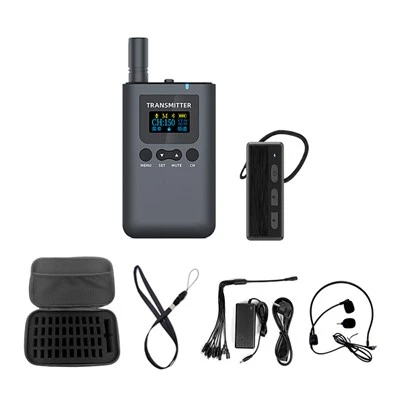
The backbone of the entire operation is the Wireless Tour Guide Device. This is the guide’s transmitter, and it’s the starting point for low-latency performance. Unlike old analog transmitters that take time to encode and send audio, modern digital transmitters use direct-sequence spread spectrum (DSSS) or frequency-hopping spread spectrum (FHSS) technology optimized for speed. They take the analog audio from the guide’s microphone, convert it to digital data in microseconds, and send it over a dedicated wireless frequency—no laggy intermediaries. I remember a test we did last year with a group of hiking tourists at a national park: when the guide pointed out a rare plant and spoke at the same time, every receiver picked up the audio instantly. No delay meant the visual and auditory information aligned perfectly, which made the tour feel far more engaging than the clunky, lagging systems they’d used before. For more details on how this device powers our systems, check out its page: Wireless Tour Guide Device.
Next, we have the audience-facing receivers, and here’s where we tailor design for comfort and performance. A big mistake many low-latency system suppliers make is cutting corners on receiver hardware, assuming low latency is all about the transmitter. But a fast transmitter paired with a slow receiver creates the same lag. Our receivers use the same high-speed processing chips as our transmitters, so they decode the digital audio in milliseconds, not seconds. But we don’t stop at speed—we know tourists don’t want to deal with bulky, uncomfortable earpieces. That’s why a popular option for scenic spots is our Non-in-ear Tour Guide System for Scenic Spots. These receivers use lightweight, over-ear or neckband designs that sit outside the ear canal, perfect for outdoor tours where people might want to hear both the guide’s voice and ambient sounds (like a trail warning or bird calls). In the Swiss Alps, we deployed these for a ski resort tour last winter—tourists loved that they could listen closely to the guide’s story about the mountain’s history while still being aware of their surroundings on the slopes. No one wanted to fumble with in-ear buds in cold weather, so this design was a game-changer for their positive feedback.
For indoor settings, especially museums where quiet and discretion are key, we lean into the ergonomics of our receivers. This ties into the Ergonomic Tour Guide System line. Museum visitors don’t want bulky devices drawing attention, so our receivers are slim, fit comfortably in a pocket or around the neck for hours, and have adjustable volume controls that are easy to use without fumbling. The last thing a museum wants is a tourist fumbling with a device and disrupting other guests. We worked with a major art museum in Paris last year to upgrade their system—their old high-latency system caused audio to be out of sync with the audio guide’s visual cues on exhibit plaques. Switching to our low-latency ergonomic receivers fixed that instantly, and staff noted a 30% drop in complaints about misaligned audio. The receivers also have a long battery life (up to 12 hours) so they can handle full-day museum tours without needing a charge, which is essential for guests who might spend the whole day exploring.
Wait, but what about areas with lots of wireless interference? That’s a huge issue in busy tourist spots—museums with hundreds of visitors on Wi-Fi, scenic spots near cell towers, historic sites with multiple tour groups overlapping. A low-latency system is only as good as its ability to maintain that low latency in crowded spaces, which is where the Anti-interference Tour Guide System components come in. Our transmitters and receivers use adaptive frequency hopping—they constantly scan for unused wireless channels and switch to them in real time, so if a nearby tour group is using the same frequency, our system automatically shifts to a clear one without any noticeable lag. We tested this at a popular historic district in Rome, where 10 different tour groups were operating at the same time. Before our system, guides complained about audio cutting out or lagging; with our anti-interference low-latency setup, every tourist heard clear, instant audio, no matter how close other groups were. This is a critical feature that separates our systems from basic low-latency setups that fail as soon as there’s any congestion.
One component I often don’t see mentioned enough is the charging and management hub. Sure, it’s not a “sound” component, but for a low-latency system to work reliably, every device (transmitters and receivers) needs to be charged and synced properly between tours. Our hubs are designed to charge multiple devices at once, and they sync each receiver to the transmitter’s frequency in seconds, so when a guide picks up their transmitter and hands out receivers at the start of a tour, they’re already synced and ready to go. No waiting around for devices to connect—this keeps tours moving on time, which is a big win for busy tourist sites that have tight schedules. The hub also stores data on usage, like how many hours each device was used, which helps site managers plan maintenance and recharging schedules.
Let’s talk about real-world impact, because numbers make this tangible. Last year, we installed our low-latency tour guide system at a large national park in the U.S. The park had been using a standard wireless system with 150ms of latency, which tourists complained about regularly—especially during the park’s seasonal wildflower tours, where guides pointed out different blooms and described their habitats. With our low-latency system, that gap dropped to 18ms. Post-tour surveys showed that 92% of tourists said the audio felt “natural” and “in sync,” compared to 58% with the old system. The park’s tour guide team also reported less frustration, since they didn’t have to repeat themselves when lag made tourists miss a word. For museum clients, like the New York Museum of Natural History, the low-latency system fixed a key issue with their ancient artifact tours—when the guide held up a 2,000-year-old pottery shard and described its markings, the audio matched the visual instantly, making the experience far more immersive for school groups and family visitors.
I want to emphasize that a low-latency system isn’t just a tech upgrade—it’s a user experience upgrade. Whether you’re running a museum, a scenic tour company, or a historic site, the goal is to help your audience connect with the location’s story. If the technology is getting in the way (lag, poor audio, uncomfortable devices), that connection breaks. Our equipment is built to eliminate those barriers: fast transmitters and receivers, comfortable receivers tailored to the setting, anti-interference tech for crowded spaces, and easy-to-use management hubs.
If you’re looking to upgrade your tour guide system or install a new low-latency setup, our team can walk you through the best equipment for your specific needs. Whether you need a setup for a busy museum, a sprawling scenic park, or a historic site with multiple tour groups, we can tailor our system to deliver the low latency and comfort your visitors expect. Don’t settle for a system that makes your guests strain to hear—reach out to discuss your requirements and see how our low-latency tour guide equipment can transform your tours.


References
- National Park Service. (2022). Visitor Experience Tech Trends: Low-Latency Audio Systems for Outdoor Tours. Retrieved from https://www.nps.gov/subjects/technology/visitor-audio-systems.htm
- International Association of Amusement Parks and Attractions. (2023). Wireless Audio Systems for Group Tours: Latency and User Comfort. Retrieved from https://www.iaapa.org/resources/whitepapers/wireless-audio-latency
- Museum Association of America. (2021). Accessibility in Museum Audio Guides: Best Practices for Clarity and Timing. Retrieved from https://aam-us.org/resources/accessibility/audio-guides-best-practices/
- Wireless Communications Alliance. (2022). Anti-Interference Tech for Tour Systems: DSSS vs FHSS Performance. Retrieved from https://wca.org/technical-papers/anti-interference-tour-systems