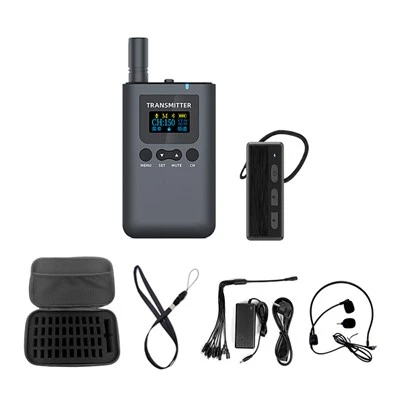
Hey there, if you've ever strolled through a museum with that little white earpiece in your ear, listening to a curator's voice tell you the story behind a 1000-year-old vase or a lost Civil War uniform, you've used a UHF tour guide system. But have you ever stopped to think, "Wait-do these things emit radiation? Am I exposing myself to something bad?" As someone who works for a company that supplies these systems to museums all over, I get this question all the time. It's totally valid, especially with how much we hear about radiation these days-from phones to Wi-Fi to microwave ovens. Today, I'm breaking down exactly what the radiation level of these museum UHF tour guide systems is, no confusing jargon, just the facts.
First, let's get on the same page about what we're talking about. UHF stands for Ultra High Frequency, right? These are radio waves in the 300 MHz to 3 GHz range, which is lower than, say, your phone's signal (that's usually 1-5 GHz, depending on the carrier) or even the 2.4 GHz Wi-Fi in your home. But wait, there are other types of tour guide systems out there too, like the 2.4G ones, which are super common for conferences. I've linked more about that 2.4G Tour Guide System for Conferences if you want to compare the two, but today we're laser-focused on UHF since that's what we supply for museums.
So, radiation. Let's split this into two types because that's the big mistake people make here: ionizing and non-ionizing radiation. Ionizing radiation is the dangerous stuff-x-rays, gamma rays, that's the kind that can damage your DNA, cause cancer, all that bad stuff. Non-ionizing radiation is the kind that's way lower energy, can't break chemical bonds, and basically just heats things up a tiny bit. All radio waves, including those from tour guides, are non-ionizing. That's a key point to start with-no, they can't give you cancer.
Now, when it comes to UHF tour guide systems for museums, there are two main parts that emit radiation: the transmitter (that's the device the museum staff wears, like a little microphone pack) and the receiver (the one you pick up at the front desk, with the earpiece). Both emit signals, but their levels are super low. Let's talk about power because that's how radiation is measured for non-ionizing stuff. The unit is watts, but since these are small devices, we usually use milliwatts (mW) or even microwatts (μW, which are 1/1000 of a milliwatt).
Our UHF tour guide devices for museums transmit at around 10 to 50 mW. Wait, that's nothing compared to your phone-your phone transmits at up to 2000 mW (2 watts) when it's got a bad signal, like in the middle of a parking garage. Even a Wi-Fi router is around 100 mW, so that's double or triple the max power of our UHF tour guides. But let's put this in perspective that's even more relatable: a standard Bluetooth headphone is around 1 mW, so our tour guide transmitters are just 10 to 50 times that. The receivers? They're even lower-they only pick up the signal, not transmit anything powerful, so their radiation level is basically negligible, like a Bluetooth device on standby.
I know what you're thinking: "Wait, but how does that compare to safety standards?" That's the part that puts my mind at ease every time someone asks. All UHF tour guide systems, including the UHF Tour Guide System for Museums we supply, have to meet strict international safety regulations. The main one is from the International Commission on Non-Ionizing Radiation Protection (ICNIRP), which sets limits for exposure to non-ionizing radiation. For the general public, the limit for UHF frequencies is about 1 W per square meter (that's the power density, the way we measure how concentrated the radiation is). Let's do the math: at the maximum distance you'd be from the transmitter in a museum (say, 10 meters, or 33 feet), the power density from our 50 mW transmitter is only around 0.000016 W/m². That's 62,500 times lower than the safety limit. No exaggeration.
But wait, is there a difference between UHF for museums and UHF for conferences? Yeah, a little. For conferences, sometimes you might have more people using the system at once, so transmitters might be set to a slightly higher power, but even then, it's still way under safety limits. If you want to check out the conference version, take a look at UHF Tour Guide System for Conferences. For museums, though, we adjust the power specifically because museum spaces are often smaller (or if they're big, there's usually a clear path between staff and guests, so we don't need max power). That's why our museum UHF systems are optimized for low power but strong enough to cut through the background noise-like people talking, art installations, the hum of HVAC systems. That's also why they're such a good pick for busy museum halls, and why they're often recommended over the older infrared systems that don't work well in sunlight or crowded areas.
Another thing people ask: do these systems cause any noticeable heating? Like, if you hold the receiver next to your ear, do you feel warm? The answer is no. Even at the closest possible distance (your ear on the receiver, which is like 1-2 cm away), the temperature increase is less than 0.1 degrees Celsius. That's barely enough to register, definitely not enough to damage tissue or cause any kind of irritation. For comparison, your laptop can get up to 40 degrees Celsius when you're using it on your lap, and your phone can get to 38 degrees when streaming a video. So these tour guides are way cooler-literally.
Wait, but let's talk about other factors that might affect radiation. Some people worry about signal interference, but that's a separate thing from radiation. High-frequency anti-interference tour guide systems use technology to make sure the signal doesn't get messed up, and those are still well within safety limits. You can read more about that High-Frequency Anti-Interference Tour Guide System if you're curious. The anti-interference tech doesn't crank up the power to do its job-it just uses smart signal processing, so the radiation levels stay the same as standard UHF systems.
I've been working with UHF tour guide devices for years, and I've never heard of a single case where someone had a health issue related to their radiation. We've had museums use our systems for big events-like the Smithsonian has a few locations with UHF guides, and they've never reported any problems. The World Health Organization (WHO) has also reviewed non-ionizing radiation from wireless devices and concluded that there's no evidence linking low-level exposure (like from tour guides) to adverse health effects. That's a big one-WHO's stance is clear here.
But let's address the elephant in the room: why do people worry about this so much? Part of it is that "radiation" sounds scary, even when it's non-ionizing. We hear the word and automatically think "dangerous," but that's not the case here. It's like how "chemicals" sound bad, but water is a chemical. Words can trick us. UHF tour guides are essentially walkie-talkies, just low-power ones. Your kid's walkie-talkie is the same frequency range, and no one thinks twice about letting them use that.
If you're a museum manager reading this, you might be thinking about what systems to get for your space. We supply the UHF Tour Guide Device that's perfect for museums-they're lightweight, have long battery life (up to 10 hours, which is enough for a full day of museum visits), and the radiation levels are so low you don't have to worry about any safety concerns for your guests, especially kids, elderly visitors, or anyone with health conditions that make them sensitive to electronics.
I should also mention that we test every single one of our systems before they leave the warehouse. We do third-party safety testing every year to make sure we're still in line with ICNIRP and local regulations, so you don't have to do any extra work to prove safety to your visitors or local health departments. That's a big relief for museum teams who already have enough on their plate-managing exhibits, staff, ticket sales, etc.


Another comparison that might help: if you stood next to a UHF tour guide transmitter for 24 hours straight, the total radiation exposure would be less than what you get from a single 10-minute walk outside. Because the sun emits non-ionizing radiation too (ultraviolet, which is also non-ionizing, though too much is bad), and just being outside exposes you to way more than a full day of wearing a museum tour guide. That puts it into super perspective-these things are basically as safe as wearing a watch.
Wait, but let's make sure we're not downplaying anything. If someone is worried, the only real way to avoid any exposure to wireless signals is to not use any. But for tour guides, that's not practical-museums need to make information accessible to large groups of people without them having to crowd around a single speaker. The alternative is using personal devices, like QR codes on exhibits that you scan with your phone, but that has its own issues: people forget their chargers, their phones die, they don't want to use their personal data, or they can't scan the code if they don't have a smartphone. UHF tour guides solve all those problems, and they're safe to use.
Let me wrap this up so it's not a wall of text. The key takeaways here are: 1) UHF tour guide systems for museums emit non-ionizing radiation, which is not dangerous and can't damage DNA. 2) Their power levels are super low-way lower than phones, Wi-Fi, and Bluetooth devices. 3) They meet strict international safety standards, tested regularly to make sure they're compliant. 4) There's no scientific evidence linking their use to any adverse health effects.
If you're a museum owner or operations manager looking to upgrade your tour guide system, we're here to help. We can walk you through all the details, answer any other questions you have about radiation levels or features, and make sure you get a system that fits your museum's needs. No pressure, just honest answers.
REFERENCES
International Commission on Non-Ionizing Radiation Protection (ICNIRP). (2020). Guidelines for limiting exposure to time-varying electric, magnetic, and electromagnetic fields (1 Hz to 100 GHz). Health Physics, 118(5), 483–524.
World Health Organization (WHO). (2021). Electromagnetic fields and public health: Radiofrequency fields (300 MHz to 300 GHz). WHO Press.
U.S. Food and Drug Administration (FDA). (2022). Radiation-emitting products: Wireless devices and radiation. FDA.gov.