

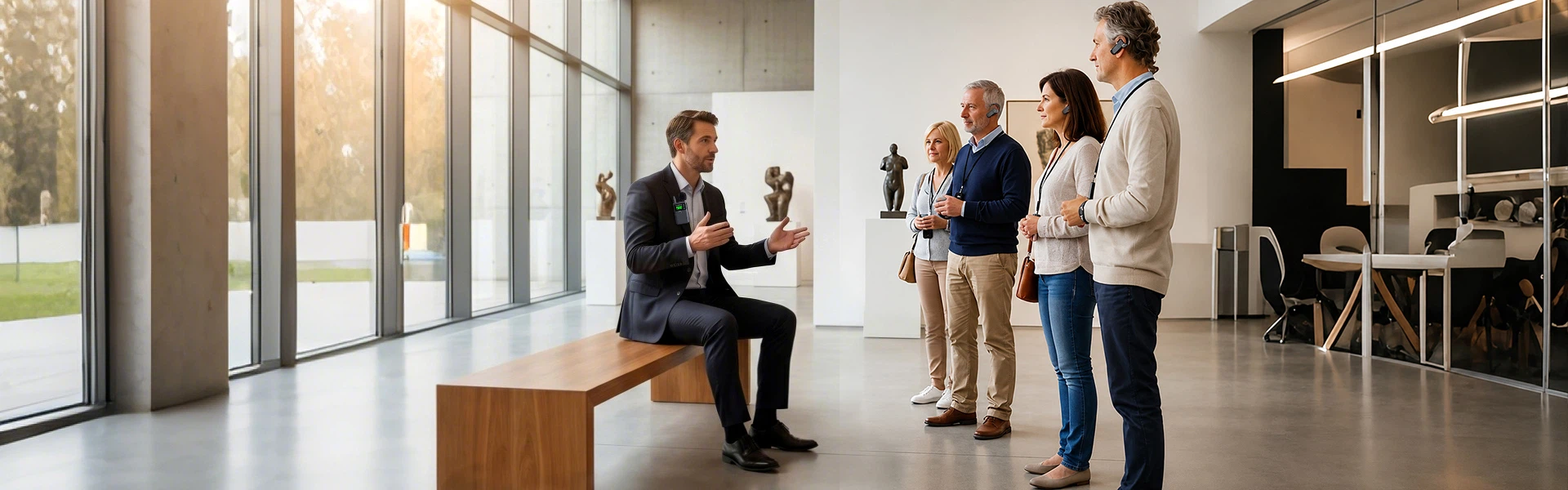
A trade show hall is one of the hardest places to be heard.
Hundreds of booths, running demos, announcements overhead and thousands of people moving at once. Yet inside that noise, small groups keep forming: a buyer delegation touring a booth, a press group following a host, a distributor team walking a product line. Each group needs someone to explain what they are looking at.
That is why a tour guide system for exhibitions is turning up more often at trade shows, expos and showrooms.
Why Exhibitions Create Guided Group Demand
Exhibitions bring many people and many products into one space. Visitors rarely have time to read everything, so organizers and exhibitors lean on guided walks.
Common examples include:
Buyer and delegation tours. Organizers walk overseas buyers through selected booths in a set order.
Exhibitor-led tours. A company hosts customers or distributors at its own booth and surrounding product areas.
Press and VIP walkthroughs. Hosts guide media or senior guests through highlights on a tight schedule.
Conference side tours. Delegates attending a conference visit nearby facilities or showrooms as part of the program.
This is a directional observation about how events operate, not a measured statistic. Your own event records are the better guide for planning.
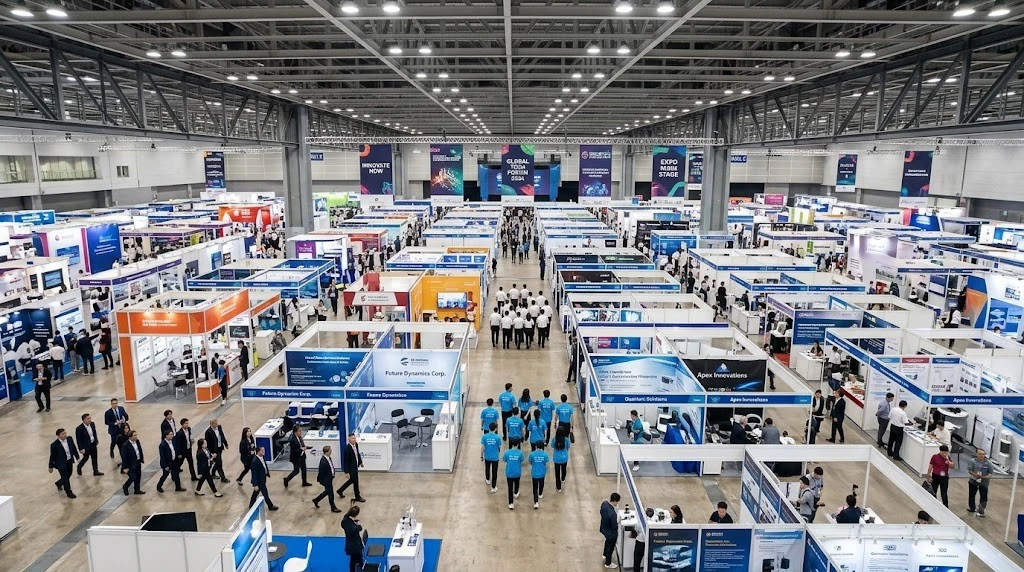
What Makes Exhibition Halls Difficult
The setting works against clear communication.
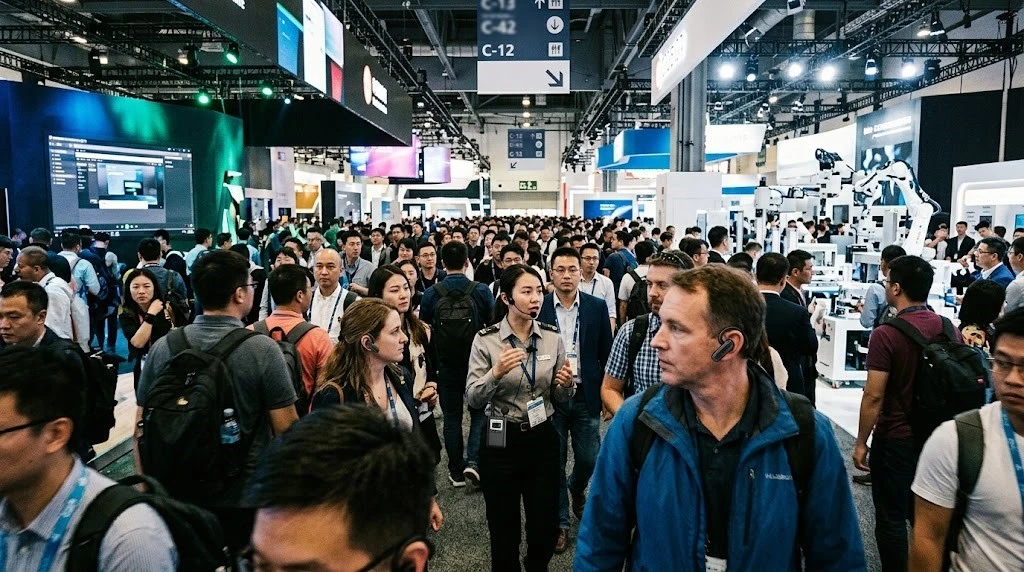
Noise. Music, demonstrations and crowds compete with the guide. Raising a voice quickly becomes exhausting over a multi-day show.
Many groups at once. Several hosts may run tours in the same hall at the same time. Without enough channels, neighboring groups hear each other.
Crowded walkways. Groups stretch out or get separated by passing crowds. A guide who is only audible within a few meters loses people.
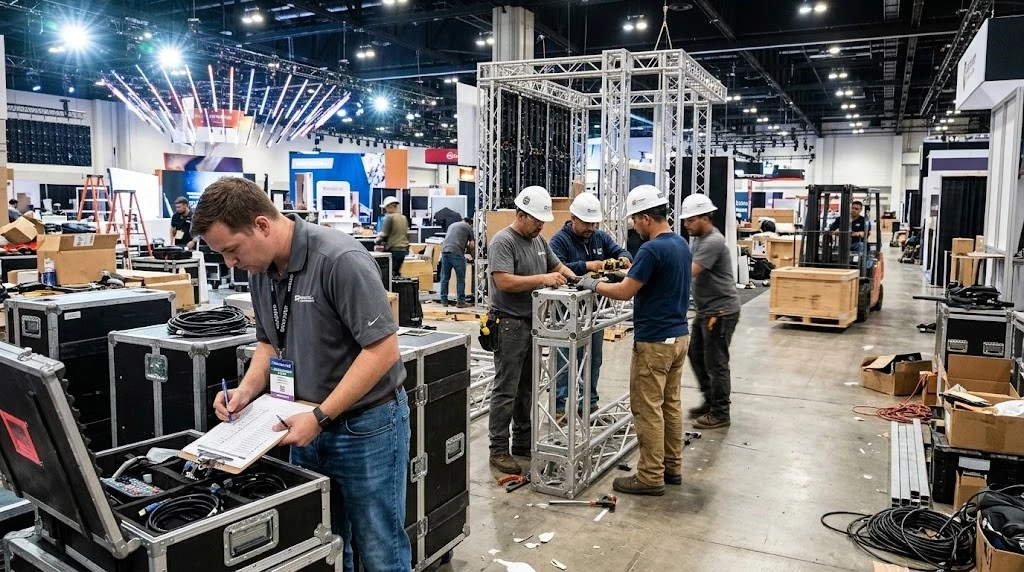
Short setup windows. Equipment often arrives close to opening day and has to work immediately.
Heavy turnover. Receivers are handed out and returned many times a day, so charging and tracking matter.

What to Look For in Exhibition Equipment
The requirements follow directly from those problems.
Enough channels. The number of simultaneous tours sets how many clean channels you need. Plan for the busiest day.
Reasonable range through crowds. Bodies and booth structures weaken signals. Check usable range inside a busy hall, not only the open-air figure.
Flexible kit sizes. Group sizes vary by show. A kit that scales in preset steps is easier to match to demand.
Fast handling. Simple issue, return and charging routines save staff time during a busy day.
Light equipment. Guides and visitors may wear it for hours, so weight matters.
999 Channels for a Hall Full of Tours
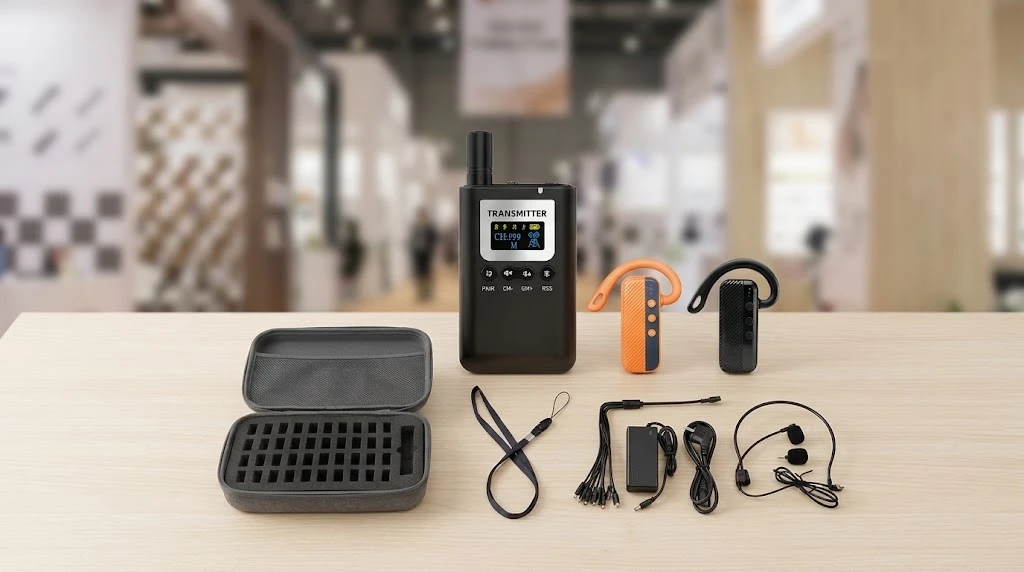
The YingMi B7-1 is a tour guide system on 2.4G with 999 available channels. For a venue where many tours run side by side, that channel count gives plenty of room to keep each group on its own clean channel.
Communication range is 50 to 300 meters depending on the environment, which covers most exhibition halls and the walkways between them. The transmitter runs about 15 working hours on a 3000mAh battery, and the receiver runs 10 to 12 hours, so a full show day is covered without a mid-day swap.
Kits scale from a 30-person set to a 500-person kit with 5 transmitters and 10 charging units, so an organizer can match equipment to the size of the event. The B7-1 also supports Bluetooth connection to mobile devices or translation equipment, which helps at international shows, and a dual-transmitter mode for a main and an auxiliary guide.
For a broader look, see the wireless tour guide system range.
A Note on Self-Guided Options
Some venues consider automatic, sensor-based audio guides for exhibitions. These play commentary when a visitor reaches a marked spot.
They work best in permanent exhibition halls and showrooms, where sensors can stay in place. For short trade shows with tight setup windows, the time needed to install and calibrate sensors usually makes live guided systems the more practical choice.
Planning Equipment for an Exhibition
A few steps keep the process simple.
Estimate the peak number of simultaneous tours on the busiest day. That sets transmitters and channels.
Walk the hall with a test unit during setup, when crowds are present, to check the real range.
Decide who issues and collects receivers, where they are charged, and how they are tracked between groups.
Confirm lead times with the supplier well before the event, especially if branding is required.
FAQs
Q: Why are tour guide systems used at trade shows?
A: Exhibition halls are noisy and crowded, and guided groups need to hear clearly. A guide system lets the host speak at a normal volume while every listener hears directly, even when walking apart.
Q: How many channels do I need for an exhibition?
A: It depends on how many tours run at the same time. Count the most simultaneous groups on your busiest day and make sure the system offers at least that many clean channels, with some spare.
Q: Can I rent tour guide equipment for a single event?
A: Often yes. Many suppliers and rental providers offer short-term options. Compare rental against purchase if events recur through the year.
Q: Can the equipment carry our event or company branding?
A: Frequently yes, through OEM options such as logo branding. Confirm lead time and a sample approval step before ordering for a specific show date.


