


Most tour guide system complaints trace back to a small handful of recurring problems, and almost all of them are avoidable if a buyer knows what to test for before purchase rather than discovering the issue mid-season with a fleet of equipment already deployed. None of these pitfalls are exotic technical failures - they're common, predictable gaps between what a spec sheet promises and what actually happens in daily operation.
Crosstalk Between Nearby Groups
This is probably the single most common complaint from venues running multiple tour groups simultaneously. A visitor hears their own guide's voice, but underneath it, fragments of a neighboring group's commentary bleed through. It rarely makes a system unusable, but it makes the experience feel unpolished, and it tends to get worse exactly during peak hours when a venue can least afford equipment problems.
The mistake buyers usually make is testing equipment in a quiet showroom, where crosstalk simply doesn't show up because there's nothing nearby to interfere with. The fix is testing under conditions that resemble your actual peak-hour environment - multiple transmitters running nearby simultaneously - before committing to a purchase, and specifically asking a supplier about available channel count relative to how many simultaneous groups your venue typically runs.

Disconnection and Dropouts
A receiver losing signal mid-tour is one of the more disruptive failures a system can have, because it doesn't just annoy one visitor - it interrupts the whole group's experience and usually requires a guide to stop and troubleshoot. Disconnection issues often trace back to range being pushed past what a venue's actual layout supports. A system rated for 200 meters in open conditions can drop connection well before that distance indoors, where walls, metal structures, and crowds all degrade signal strength faster than open-air test conditions would suggest.
The practical fix here is treating a spec sheet's range number as a best-case ceiling, not a guarantee, and walking the actual intended tour route with a test unit - around corners, through doorways, past metal fixtures - before assuming a system's coverage matches your venue.

Battery Life That Doesn't Match Real Usage
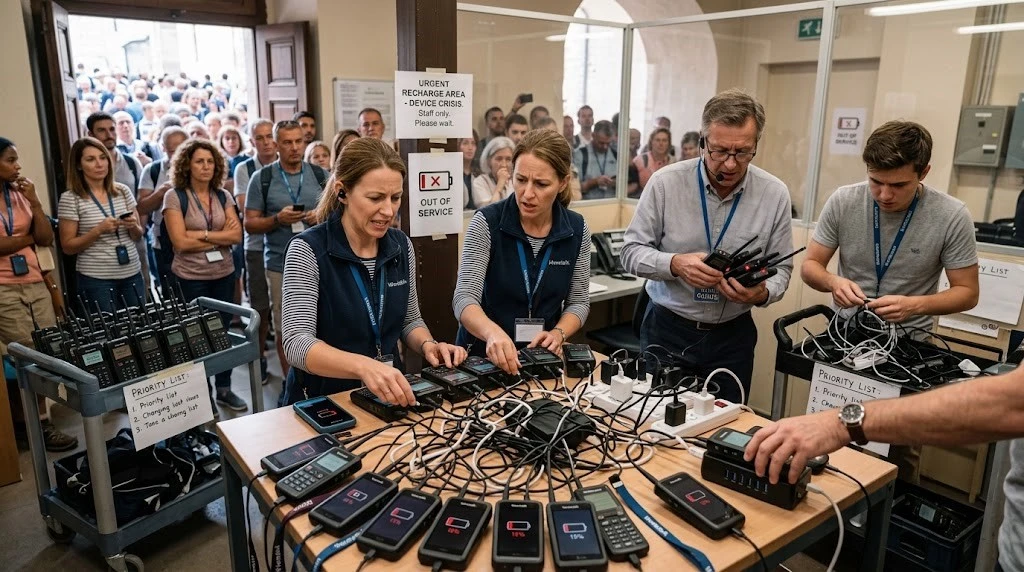
This is a subtler pitfall, because it doesn't usually show up as an outright failure - it shows up as equipment that "should" last the day but doesn't quite, forcing staff into an unplanned mid-shift charging scramble. Manufacturer-published battery figures are often measured under specific test conditions - moderate volume, consistent transmission - that don't always match a venue's actual usage pattern. A venue running equipment at higher volume, in hot outdoor conditions, or with more continuous transmission than a lab test assumed will typically see somewhat shorter real-world battery life than the number on the spec sheet.
The way to avoid getting caught out by this is straightforward but often skipped: run a full-day trial under your venue's actual conditions before committing to a large equipment order, and look for battery ratings that comfortably exceed your longest operating day rather than ones that just barely match it.
Assuming Kit Size Scales Cleanly With Visitor Count
A less obvious pitfall shows up during peak season, when a venue that sized its equipment purchase around average daily visitor counts suddenly finds itself short during a holiday weekend or a large group booking. Kit configurations are usually built around specific group-size tiers, and jumping from a 100-person kit to genuinely needing 150 receivers on a busy day isn't something most venues catch until it's already happening.
The fix is sizing equipment purchases around realistic peak-day demand, not average demand, and building in enough buffer capacity that an unusually busy day doesn't turn into a scramble to source additional receivers on short notice.

Underestimating After-Sales and Warranty Terms
This pitfall doesn't show up until months after purchase, which is exactly why it's easy to overlook during the buying decision. Equipment used daily accumulates wear faster than occasional-use electronics, and a supplier with slow replacement turnaround or minimal warranty coverage can turn a single failed unit into weeks of reduced operating capacity. Buyers focused primarily on upfront price sometimes skip asking directly about warranty length, spare parts availability, and typical repair or replacement turnaround - questions that matter far more once equipment has been in daily use for a season or two than they seem to during the initial purchase conversation.
The Common Thread
Nearly all of these pitfalls share the same root cause: relying on spec-sheet numbers and showroom demos instead of testing equipment under conditions that resemble actual daily use. A system that performs flawlessly in a quiet, controlled demo can behave very differently once it's facing a busy Saturday, an outdoor summer afternoon, or six months of continuous daily handling. Buyers who build in a realistic trial period - testing range, crosstalk resistance, and battery life under real operating conditions - before committing to a full equipment order tend to avoid most of these problems entirely, rather than discovering them after a season of frustrated staff and inconsistent visitor feedback.
FAQs
Q: Is crosstalk a sign of defective equipment, or is it normal to some degree?
A: Some crosstalk risk exists with any wireless system operating near other transmitters, but a well-designed system with adequate channel capacity should keep it rare and minor. Frequent, noticeable crosstalk generally points to insufficient channel separation for how many groups a venue is running simultaneously, rather than a hardware defect.
Q: How much shorter is real-world battery life typically compared to the advertised figure?
A: This varies by manufacturer and usage pattern, but it's reasonable to expect some gap between lab-rated and real-world performance, particularly at higher volume levels or in hot outdoor conditions. This is why testing under your venue's actual conditions matters more than comparing spec-sheet numbers alone.
Q: What's the easiest way to avoid most of these pitfalls before committing to a purchase?
A: Requesting a trial period or on-site demo under conditions similar to your actual peak operation - multiple groups running nearby, your venue's real layout, a full operating day - catches most of these issues before they become a problem with a fleet of equipment already purchased.


