


Most people shopping for a tour guide system assume the setup is always the same: one guide talks, a group of visitors listens. That's true for the majority of tours, but it's not the only way these systems get used. Some visits genuinely need more than one speaker - a facility host handing off to a technical specialist, two officials alternating remarks during a delegation visit, or a rotating cast of docents covering different sections of the same tour. Buying equipment built only for a single speaker, then trying to force a multi-speaker visit through it, tends to produce exactly the kind of clunky mid-tour handoff that makes a reception or event feel less polished than it should.
What One-to-Many Actually Covers
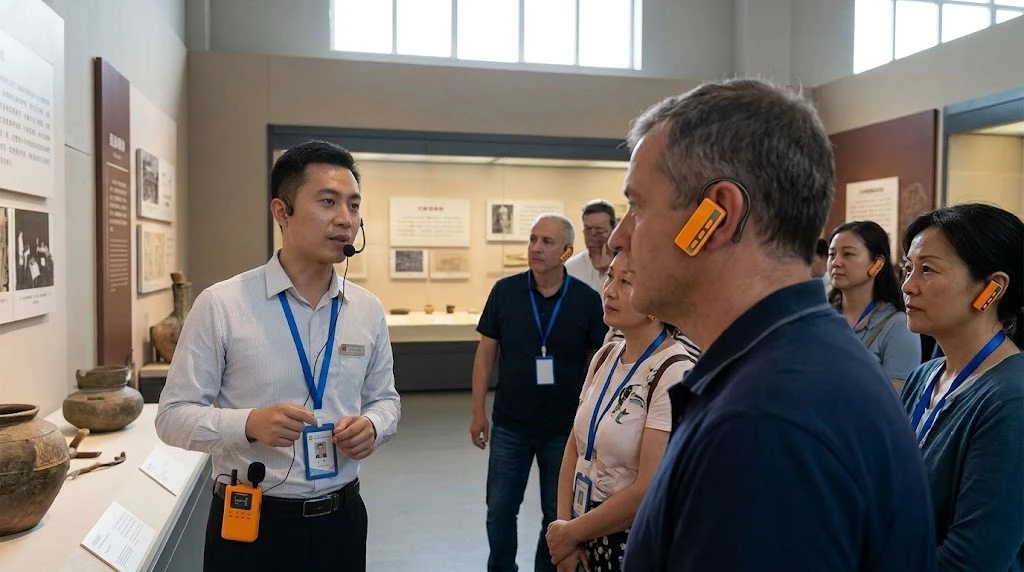
One-to-many is the standard team guide setup: a single transmitter, held or worn by one guide, broadcasting to as many receivers as the kit includes. This covers the overwhelming majority of tour use cases - scenic area walking tours, standard museum group visits, factory walkthroughs led by a single guide - and it's what most of YingMi's team guide systems, including the B7-1 and A8, are built around. The kit scales by adding more receivers and charging capacity, not by adding more transmitters, since there's only ever one voice being broadcast at a time.
This structure works well specifically because it's simple. There's no handoff to manage, no risk of two transmitters accidentally overlapping on the same channel, and setup is close to foolproof for staff running back-to-back tours all day.
Where One-to-Many Starts to Fall ShortProducts Description
The gap shows up the moment a visit genuinely needs more than one voice. A government delegation tour where a facility director introduces the visit, then hands off to an engineer for the technical portion, doesn't fit neatly into a single-transmitter setup - someone has to physically pass the transmitter, and that pause is noticeable, especially in a setting where the whole point is a polished, professional impression. The E8's main-and-sub dual talk function addresses this specific gap for two-speaker handoffs, letting a second speaker join in without a physical exchange of equipment.
What Multi-to-Many Adds
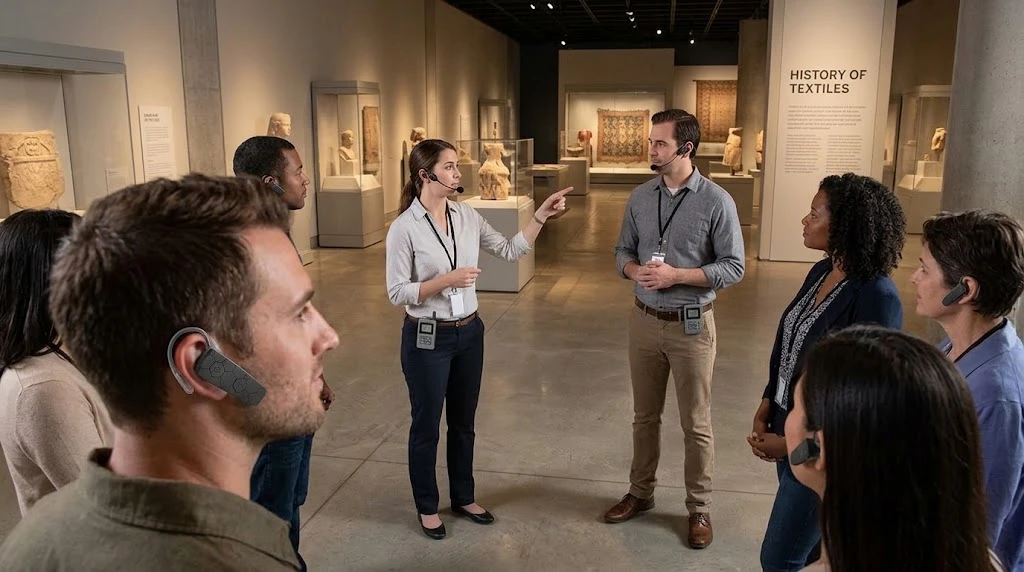
Multi-to-many setups extend this further, supporting three, four, or more speakers switching in and out of the same tour without re-pairing equipment or handing devices back and forth. This matters most for larger, more complex reception and institutional visits - a multi-department facility tour where a different specialist speaks in each section, or a large delegation visit with several officials each covering a different topic.

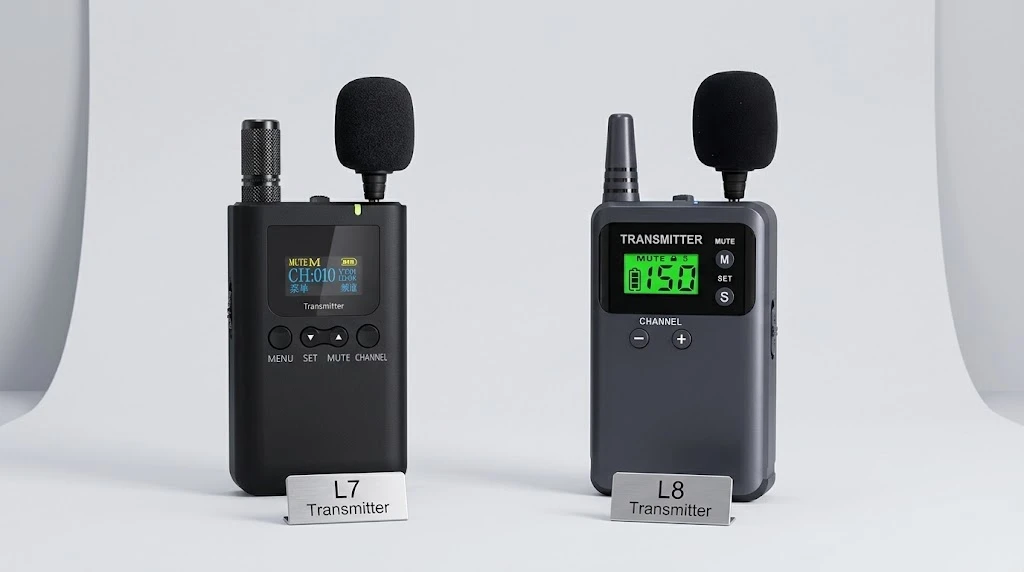
The L7 tour guide device supports multi-guide operation for up to 3 speakers, while the L8 tour guide system extends that to 3–5 speakers, giving venues running genuinely complex, multi-voice visits a system built for that structure from the start rather than adapting single-speaker equipment to fit. Both retain standard team guide fundamentals underneath - the L7 runs on dual 2.4G/UHF frequency with up to 150 adjustable channels and a communication range up to 200 meters, while the L8 operates on UHF with the same 150-channel transmitter capacity and a range up to 300 meters. Both also support Bluetooth connection to mobile devices or translation equipment, useful for multi-speaker events that also need real-time translation layered in.
Deciding Which Structure Actually Fits
The decision mostly comes down to a straightforward question: during a typical visit, does more than one person need to speak into the system? If the answer is consistently no - a single guide, start to finish, every tour - a standard one-to-many system is simpler to operate and manage, and there's no real benefit to paying for multi-guide capability that won't get used. If visits regularly involve a handoff between two or more speakers, particularly in reception, institutional, or multi-department settings, the smoother handoff and professional presentation of a multi-guide system tends to be worth the difference, especially for organizations where every visitor touchpoint reflects on the host.
It's also worth checking how many speakers realistically need to be active, since this isn't a one-size question - a two-speaker handoff (E8) is a meaningfully different requirement from a five-speaker rotation across a large facility (L8), and matching the system to the actual number of voices involved avoids both underbuying and overpaying.
FAQs
Q: Can a one-to-many system be upgraded to multi-to-many later, or does it require different hardware?
A: Multi-guide support is built into the transmitter and system design from the start, so it generally isn't something added to existing one-to-many equipment after purchase. Venues anticipating multi-speaker needs should factor this into the initial equipment selection rather than planning to upgrade later.
Q: Does adding more speakers to a system increase the risk of signal interference?
A: Not inherently - multi-guide systems like the L7 and L8 are designed to manage multiple transmitters switching in and out cleanly, within their available channel capacity. Interference risk relates more to how many separate tour groups are operating nearby simultaneously than to how many speakers are sharing one tour's system.
Q: Is multi-to-many overkill for a standard scenic area or museum tour?
A: For most standard single-guide tours, yes - a one-to-many system like the B7-1 or A8 covers this use case well without the added complexity multi-guide support introduces. Multi-to-many is worth considering specifically for reception, institutional, or multi-department visits where more than one person regularly needs to speak.


