

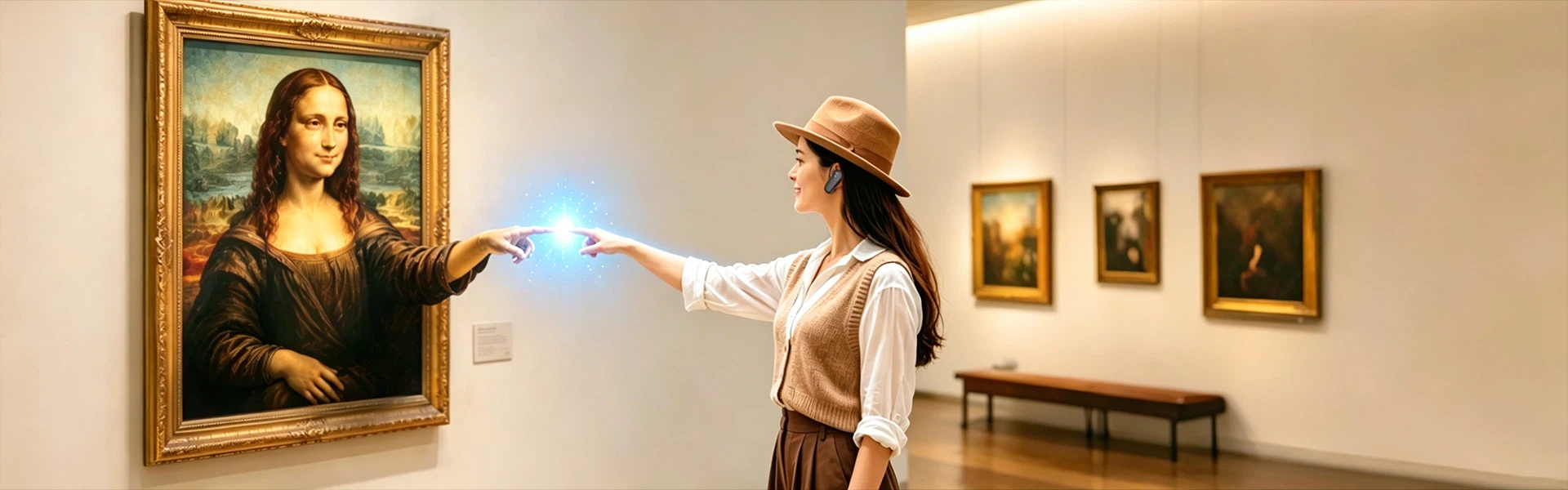
International exhibitions are dense, loud, and fast. Hannover Messe, the Canton Fair, Bauma, Arab Health - these events pack hundreds of thousands of visitors into spaces that were never really designed for quiet conversation. An exhibitor might spend months preparing a product demonstration, then deliver it to a buyer delegation from three different countries who walk away having understood maybe half of what was said. Not because the product wasn't good. Because the conditions were against them from the start.
That's the gap tour guide systems are built to close.
The actual problem on the show floor
Exhibition noise is a different beast from ordinary background noise. It's layered - machinery running, neighboring booths competing for attention, PA systems overlapping, crowds moving. A normal speaking voice carries maybe two or three meters before it gets swallowed. Try addressing a group of fifteen people standing in a semicircle around you and you'll notice the ones on the edges starting to lean in, then giving up, then pulling out their phones.
Add a language barrier and the situation compounds quickly. Most international exhibitors work with one interpreter, maybe two. That interpreter is standing next to the presenter, whispering or speaking quietly to a small cluster of people - which means anyone more than two rows back has stopped following. A good chunk of the room is effectively on their own.
What a tour guide system actually does
The setup is straightforward: the presenter wears or holds a small transmitter with a clip-on mic. Each visitor gets a pocket-sized receiver and an earpiece. Whatever the presenter says goes directly into everyone's ear simultaneously - clearly, regardless of where they're standing or how loud the hall is.
On multichannel systems, you layer interpretation on top. Channel 1 is English. Channel 2 is the interpreter working in Japanese. Channel 3, German. Visitors tune their receiver to their language. The presenter talks once; every delegation hears it in their own language at the same moment. No lag, no waiting, no one left out.
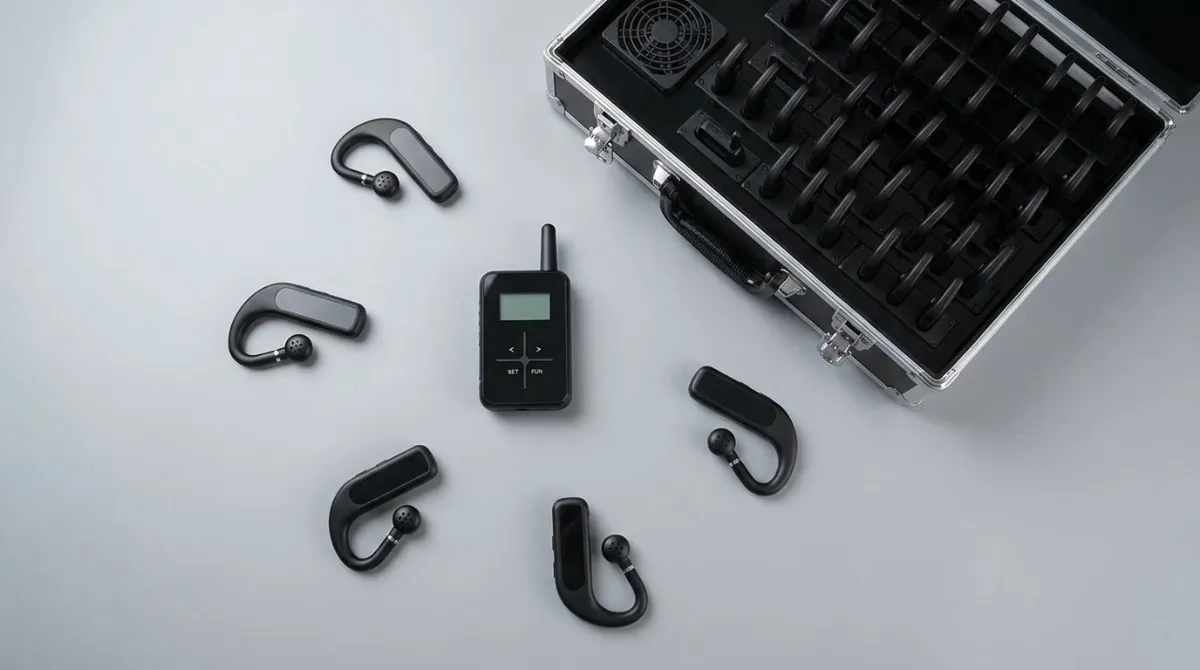
🎙️Transmitter
Handheld or clip-worn by the presenter. Picks up voice and broadcasts wirelessly across the group.
🎧Receivers
One per visitor. Compact, easy to hand out, with a channel dial for language selection.
🔋Charging case
Charges and stores units between sessions. Important when you're running delegations back-to-back across a three-day show.
📡Two-way option
Some systems let visitors transmit back - useful for Q&A during technical presentations or factory walkthroughs.
Where this matters most at trade shows
The obvious use case is the booth presentation - a product demo, a machinery walkthrough, a scheduled briefing for a buying delegation. But the equipment earns its keep in a few situations that don't get talked about as often.
Factory tours that run alongside an exhibition are one. Visitors pile onto a bus, get taken to a production facility, and spend two hours walking through loud manufacturing floors while someone at the front shouts explanations. Without a guide system, the visitors at the back of the group get almost nothing. With one, they get the same experience as the people standing right next to the guide.
Hosted buyer programs are another. These are the curated tours where procurement teams move through multiple exhibitor booths in sequence - sometimes ten or twelve stops in a single day. Handing receivers to a group at the beginning of the day and collecting them at the end is a much smoother experience than trying to improvise audio arrangements at each stop.
- Multilingual product demos with simultaneous delegations from different countries
- Factory and production-site tours running adjacent to the main show
- VIP buyer programs with curated, multi-stop itineraries
- Technical briefings where accuracy of detail matters - medical devices, industrial equipment, chemicals
- Confidential presentations where you don't want neighboring booths overhearing your pricing conversation
One detail worth mentioning: in densely packed exhibition halls, RF interference is real. Wi-Fi, Bluetooth, other wireless systems all compete for spectrum. Anti-interference technology - typically UHF or 2.4 GHz digital transmission with frequency-hopping - makes a significant difference between a system that works reliably and one that crackles out at inconvenient moments.

Choosing the right system
Battery life is the thing most people underestimate. A three-day exhibition with multiple sessions per day puts real demands on equipment. A system that runs eight hours is fine for a single-day event; for a major international show, you want something that either lasts a full day on a single charge or recharges fast enough between sessions.
Ease of use matters more than most spec sheets acknowledge. Exhibition staff are busy. Visitors are impatient. If handing out and collecting receivers adds five minutes of confusion to the start of every session, that friction adds up. The best systems are genuinely simple - pick it up, press a button, hear the presenter. That's it.
Range is worth checking against your actual venue. A 100-meter range is fine for a standard booth presentation. A factory tour through multiple buildings is a different situation - you'll want something with extended range or repeater capability.
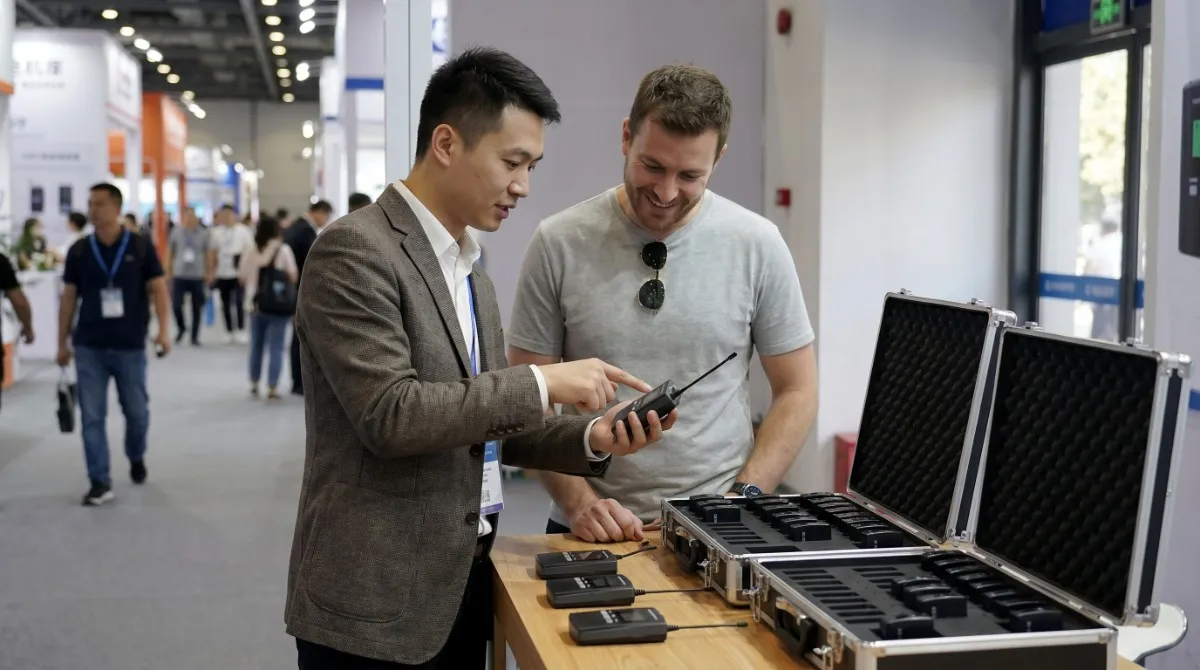
A manufacturer worth knowing: Yingmi
If you're sourcing tour guide systems for exhibition use, Yingmi is one of the more serious options in the market. They've been manufacturing wireless audio guide equipment since 2007 - long enough to have worked through the problems that catch newer entrants out - and their product range covers most of what international trade show use requires: anti-interference UHF systems, multichannel configurations for simultaneous interpretation, two-way units, and portable setups that travel well.
Their equipment carries CE, FCC, and RoHS certification, which matters when you're deploying gear at events in Europe, North America, and across Asia. They also offer OEM customization - corporate branding on the hardware itself - which is a detail some exhibitors use to reinforce their brand throughout a delegation visit.
For trade show organizers or exhibitors who need to equip a large group and want the setup to just work, Yingmi is a practical starting point.
A practical note to close
The ROI on tour guide equipment at a major international exhibition is not hard to calculate. If a delegation of twenty buyers leaves your booth having actually understood your product - its specs, its differentiators, the pricing logic - versus leaving with a vague impression and a brochure they'll probably not read, that difference is worth more than the cost of renting or buying a set of receivers.
It's a small piece of infrastructure. Most exhibitors who try it once don't go back to doing without it.


