


Walk into a major museum on a Saturday afternoon, or step onto a trade show floor during peak hours, and the air is thick with more than just noise. Wi-Fi routers, other exhibitors' audio equipment, walkie-talkies, and dozens of competing tour groups are all sending signals through the same limited stretch of radio spectrum. For a wireless tour guide system, that congestion is the real test. A device that performs flawlessly in a quiet showroom can fall apart the moment it enters a venue with fifteen other transmitters running at once.
This is why anti-interference performance, not just audio clarity in isolation, has become the defining spec that separates reliable tour guide equipment from equipment that merely sounds good on a spec sheet.
Where the interference actually comes from
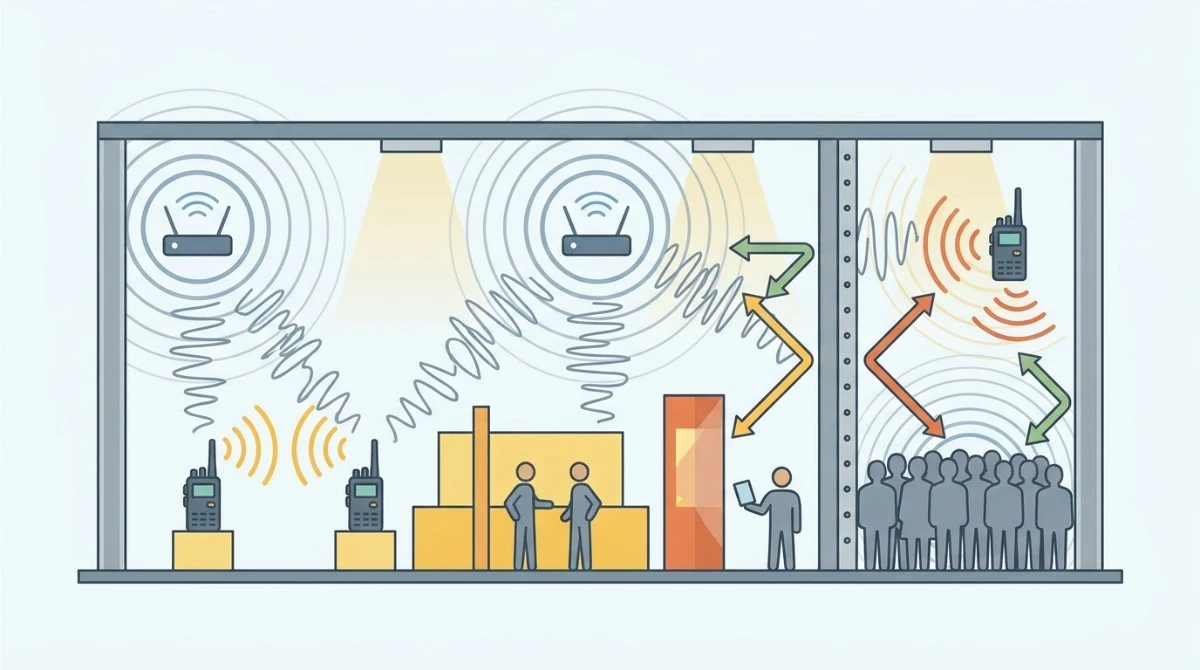
Interference in guided-tour environments tends to come from three overlapping sources. The first is spectral crowding: in any venue hosting multiple simultaneous groups, dozens of transmitters may be active in the same frequency range at the same time. Without proper channel separation, one group's commentary bleeds into another's headset, and visitors hear overlapping voices instead of their own guide.
The second source is environmental RF noise, meaning signals from unrelated equipment such as building Wi-Fi, security radios, and other wireless devices sharing nearby bands. The third is physical interference: metal structures, concrete walls, and dense crowds of people all absorb or reflect radio signals, weakening the connection between transmitter and receiver even when no other device is competing for spectrum.
A tour guide system that only solves one of these problems will still fail in the field. Genuine reliability requires addressing all three.
The engineering behind interference resistance
Manufacturers approach this problem from a few angles at once, and the better systems combine them rather than relying on a single fix.
Frequency band selection is the starting point. Many tour guide systems operate in globally recognized license-free bands, such as the 860–870 MHz range, precisely because these bands are set aside for this type of short-range communication and are less likely to collide with licensed broadcast or public-safety traffic. Choosing a well-managed frequency band reduces the odds of interference before a device even leaves the factory.
Modulation method matters just as much. Systems built on Gaussian Frequency Shift Keying, commonly known as GFSK, encode audio as digital frequency shifts rather than analog amplitude changes. Because the receiver only needs to distinguish between discrete frequency states rather than interpret continuous signal strength, GFSK-based systems tolerate a noisier RF environment far better than older analog designs, which is one reason the modulation scheme has become close to standard across the industry.
Multichannel architecture is the third pillar, and arguably the one that matters most in crowded venues specifically. Rather than giving every transmitter the same frequency, multichannel systems divide the available spectrum into dozens or hundreds of discrete channels, so multiple tour groups, translation booths, or exhibitor demonstrations can run simultaneously without their audio streams interfering with one another. The more channels a system supports, the more independent groups a single venue can host at once, which is why venues with heavy daily group traffic, such as major museums or exhibition halls, tend to prioritize channel count almost as highly as audio quality when specifying equipment.

What this looks like in practice
The gap between a system's theoretical spec sheet and its real-world performance shows up clearly in high-noise, high-density environments.
Factory and industrial-site tours are a useful example. Manufacturing floors combine constant machinery noise with metal structures that reflect and scatter radio signals, an environment that is genuinely difficult for standard consumer-grade audio equipment. Yingmi 008A wireless tour guide system was engineered around exactly this scenario, operating on a stable UHF band between 935 and 955 MHz with anti-interference circuitry designed to keep a guide's voice intelligible over workshop noise. Plant managers hosting overseas buyers, government delegations, or distributor visits use this kind of setup specifically because ordinary handheld speakers or megaphones tend to lose the room the moment machinery starts running.

Museums and large public attractions present a different but related challenge: not constant noise, but constant channel competition, since many independent tour groups may be moving through the same galleries at the same time. Here, multichannel tour guide systems earn their keep by assigning each group its own interference-resistant channel automatically, so a family tour, a school group, and a paid docent-led tour can all pass through the same room without their commentary crossing streams. Systems with automatic channel assignment remove the need for staff to manually coordinate frequencies across groups, which matters in venues running back-to-back tours throughout the day.
What buyers should actually check
For venue operators and equipment resellers evaluating tour guide systems, a few practical checks separate genuinely interference-resistant equipment from products that simply advertise the term.
First, confirm the operating frequency band and whether it is a globally recognized license-free allocation, since a system tuned to a regionally restricted band can run into legal or performance issues when deployed internationally. Second, ask specifically about modulation type; GFSK or comparable digital modulation is a meaningful indicator of RF resilience, not a marketing footnote. Third, check channel count relative to expected simultaneous usage. A venue running four or five concurrent tours needs meaningfully more headroom than that number suggests, since nearby buildings, staff radios, and public Wi-Fi all consume channels too.
Finally, ask for real-world range and reliability figures under load, not just open-field range claims. A transmitter rated for two hundred meters in an empty parking lot behaves very differently once it is competing with concrete, metal shelving, and a few hundred visitors' worth of body mass between transmitter and receiver.

The bottom line
Interference resistance is not a single feature that can be checked off a list. It is the result of frequency planning, modulation choice, and channel architecture working together, tested against the specific noise and density conditions of the venue in question. For operators choosing between systems, the right question isn't whether a product claims to be interference-resistant, but which combination of frequency band, modulation, and channel capacity it actually relies on to make that claim true under real conditions.


