

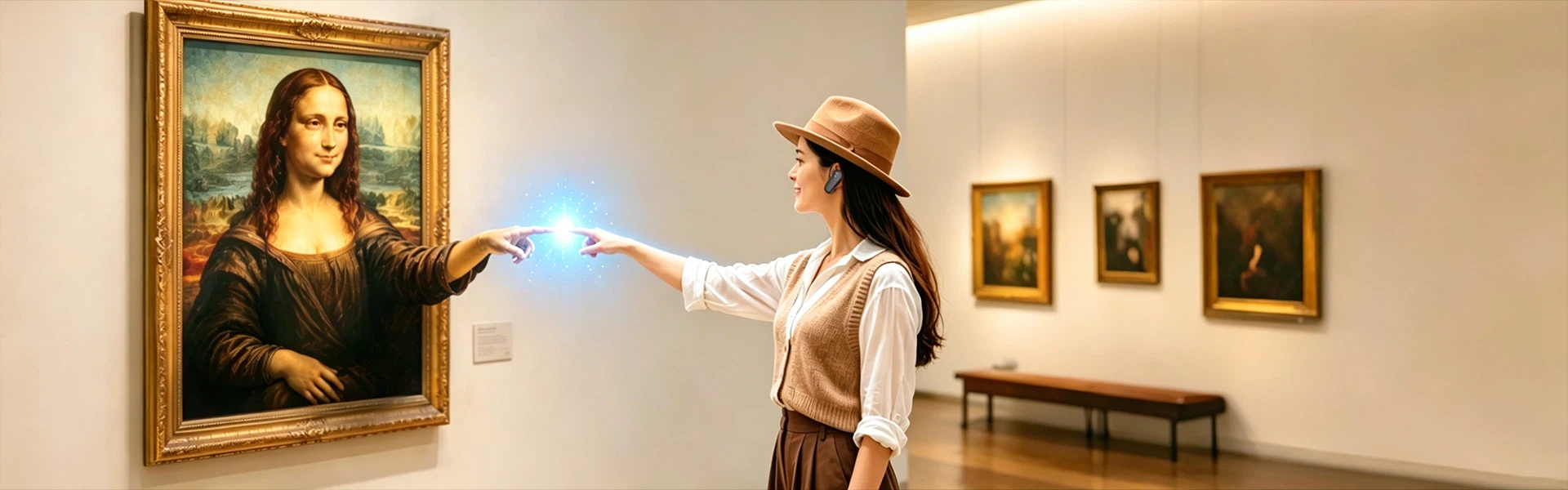
AI-Powered Voice Technology and Multilingual Guided Tours
Undoubtedly, the integration of AI technology marks the most intuitive advancement in audio guides. I once tested an AI-enabled guide device at a provincial museum. Instead of manually entering numbers, it automatically pushed narrations for corresponding exhibits based on my visiting route. It could even respond in real time to casual questions I asked, such as "What is the historical background of this cultural relic?" - far more flexible than traditional audio guides. Its multilingual function is particularly useful for foreign visitors. In the past, one could often see overseas tourists at a loss when viewing exhibits; now AI-driven multilingual guides help them easily learn the stories behind cultural relics.
IDC's Global AI Applications Trend Report for Cultural Tourism Industry 2025 states that the adoption rate of AI voice guides in cultural venues will exceed 50% by 2027, a figure I find hardly surprising. Yet to me, the core of AI guides lies not in recognition or translation capabilities, but in telling compelling stories well.
I have noticed that although some manufacturers offer AI guide devices with multilingual support, pronunciations of certain minor languages are substandard, and localised cultural interpretations sound rigid. For instance, when explaining traditional Chinese cultural relics, they fail to convey underlying folk connotations and historical contexts. Furthermore, there are vast technological gaps between different suppliers: some AI systems suffer low recognition accuracy and malfunction in noisy environments, ruining the visiting experience instead.
In my opinion, a high-quality AI guide should act as a warm-hearted assistant rather than a cold voice recorder. Future improvements need to focus on algorithm optimisation and content localisation.

AR/VR and Immersive Guided Tours
From personal experience, AR and VR technologies make museum guided tours more engaging. At the National Marine Museum, I tried an ocean creature exhibition with AR glasses. Thanks to virtual scene reconstruction, dormant specimens seemingly came to life, allowing visitors to directly observe their activities in the ocean - an immersive experience irreplaceable by traditional audio guides.
Yet beyond the novelty, I spotted several flaws, most notably wear comfort. Most AR glasses are bulky, causing dizziness and nasal pressure after less than 20 minutes of wear, making them unsuitable for long-duration museum visits. This is why many tourists abandon them after a single trial.
Besides, deploying AR/VR guided tours involves high barriers to entry. According to museum staff, realising AR/VR presentation for each exhibit requires specialised 3D modelling, animation and interactive design, which is time-consuming and labour-intensive. Subsequent updates and maintenance also incur high costs.
In addition, inconsistent hardware standards among manufacturers lead to poor device compatibility, creating operational headaches for museums. Suzhou Museum's Cloud Viewing Museum app, for example, uses mobile-phone-based AR instead of professional glasses, cutting costs while ensuring user experience. Such lightweight solutions are more suitable for most small and medium-sized museums.
To my mind, AR/VR guided tours should not be exclusive to high-end venues. Only by addressing cost and comfort issues can they enter more museums and become vital supplements to audio guides in the future.

Precision Positioning and Zone-Based Guided Tours: Details Define the Upper Limit of User Experience
Zone-based guided tours solve the pain point of overlapping narrations in large-scale museums, a problem I have experienced firsthand.
In the past, visiting major venues such as the Palace Museum and the National Museum of China often meant multiple audio guides playing simultaneously, with overlapping noises making narrations unintelligible. Zone-based guiding uses positioning technology to automatically trigger content for different exhibition areas, enabling tourists to hear explanations clearly and avoiding noise chaos within zones.
However, implementing this technology is far more complex than imagined. I once encountered an awkward issue at a multi-storey museum: narrations suddenly cut off at the boundary between exhibition zones. Staff explained that Bluetooth positioning was disrupted by metal structures. Later I learned that both Bluetooth and UWB positioning are prone to unstable signals and inaccurate positioning in multi-storey exhibition halls with abundant metal components. Moreover, simultaneous multi-channel playback requires balancing signal crosstalk and volume equalisation, and minor oversights can ruin user experience.
In my view, the key to zone-based guiding is not ultra-high positioning precision, but signal planning aligned with museum layouts. Some museums adopt a multi-mode positioning solution combining Bluetooth beacons and image recognition, which effectively mitigates interference. This shows that technological deployment should not focus merely on technical parameters but adapt to actual venue environments. Refined details are the key to elevating tourist experience.

Cloud-Based Management and Data Analysis
The integration of the Internet of Things (IoT) and cloud-based management has greatly boosted the efficiency of museum audio guide device management.
I know an operation and maintenance staff member from a museum, who told me that previously he had to manually inspect hundreds of guide devices daily, a time-consuming task. Device malfunctions were usually only discovered after tourist complaints. Now, cloud-based management enables real-time monitoring of device status and usage frequency, and even predicts failures for proactive maintenance. According to him, network-connected device management has reduced operational and maintenance costs by around 20%, proving to be a valuable asset for museum operations.
Nevertheless, the value of cloud-based management extends beyond device monitoring to effective data utilisation. Many museums collect massive volumes of tourist data yet only conduct simple usage-frequency statistics, failing to analyse visitor preferences in depth - such as which exhibit narrations are repeatedly played and which zones attract longer stays. Such data can help museums optimise exhibition layouts and narration content to better cater to tourist needs.
Meanwhile, I have a concern: cloud-based management involves extensive data including visitors' visiting trajectories and personal preferences, mandating strict data security and privacy protection. Any information leak will damage tourist trust and harm the museum's reputation.
Additionally, small-scale museums often lack robust backend data analysis capabilities. Even with cloud-based management deployed, they struggle to unlock data value and face increased operational complexity - another issue to be resolved in the future.

.
Case Insights: What Suits One Is the Best
After visiting numerous museums, my biggest takeaway is that no single technology is universal; the key lies in compatibility with venue realities.
Self-service audio guide devices trialled by many audio guide manufacturers in large museums do support multilingual playback and automatic zone-based triggering. Yet staff admit that professional human-led explanations are still required for certain special exhibits needing expert interpretation. Yingmi M7C audio guide device supports both self-guided visits and human tour guide narrations, offering human warmth that machines cannot replicate.
This reinforces my viewpoint: when selecting guiding technologies, museums should not blindly pursue high-tech solutions. Instead, they should adopt tailored technology combinations based on their scale, budget, target visitors and spatial layouts, ensuring technologies truly serve tourists rather than becoming ornamental gadgets.

Comprehensive Reflections and Future Trends: Technology Returns to Its Essence to Serve Cultural Communication
To me, the future of museum audio guide systems lies not in stacking technologies, but in the collaborative optimisation of technology, scenarios and operations. Many venues hastily adopt new technologies such as AR/VR and AI while overlooking basic user experience issues: for example, overly complicated guide device operations confusing elderly visitors, rigid narration content failing to engage tourists, and frequent device malfunctions left unattended. Without solving these problems, even cutting-edge technologies are meaningless.
Going forward, audio guide systems should advance in the following directions:
First, improve environmental adaptability to tackle unstable signals in noisy and complex spaces for clearer narrations.
Second, promote synergy between content and technology: both AI narrations and AR experiences must align with exhibits' cultural connotations, helping visitors truly understand the stories behind cultural relics.
Third, strengthen data-driven management to empower exhibition optimisation and operational improvements via cloud data, rather than conducting superficial data statistics only.
Fourth, balance scalability and cost to make solutions affordable and user-friendly for museums of all sizes.
Ultimately, the core purpose of museum audio guides is to serve tourists and spread culture, with technology merely a tool to achieve this goal. As a museum enthusiast, I do not expect over-hyped high-tech guide systems, but ones that make museum visits more enjoyable and meaningful - enabling everyone to appreciate the value of cultural relics and the charm of culture through guided tours. In the future, only by returning technology to its essence, adapting to scenarios and serving tourists, can we truly shape the future of museum audio guide systems.


